


Page 158 - Gas Purification 5E
P. 158
146   Gas Puripcation


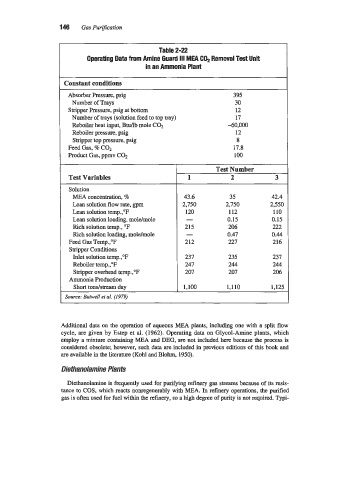
                                                Table 2-22
                           Operating Data from Amine Guard 111 MEA C&  Removal Test Unit
                                            in an Ammonia Plant

                    Constant conditions
                     Absorber Pressure, psig                          395
                      Number of Trays                                  30
                     Stripper Pressure, psig at bottom                 12
                      Number of trays (solution feed to top tray)      17
                       Reboiler heat input, Btdb mole C02            -60,000
                       Reboiler pressure, psig                         12
                       Stripper top pressure, psig                     8
                     Feed Gas, 8 C02                                  17.8
                     Product Gas, ppmv CO,                            100
                                                                 Test Number
                     Test Variables                      1           2            3
                     Solution
                       MEA concentration,  %I          43.6          35          42.4
                       Lean solution flow rate, gpm    2,750        2,750        2,550
                       Lean solution temp.,"F           120          112          110
                       Lean solution loading, moldmole   -          0.15         0.15
                       Rich solution temp., "F          215          206          222
                       Rich solution loading, moldmole   -          0.47         0.44
                     Feed Gas Temp.,"F                  212          227          216
                      Stripper Conditions
                       Inlet solution temp.,"F          237          235          237
                       Reboiler temp.,"F                247          244          244
                       Stripper overhead temp.,"F       207          207          206
                      Ammonia Production
                       Short tondstream day            1,100        1,110        1,125


                   Additional data on the operation of  aqueous MEA plants, including one with a split flow
                   cycle, are given by  Estep et al. (1962). Operating data on Glycol-Amine plants, which
                   employ a mixture containing MEA and DEG, are not included here because the process is
                   considered obsolete; however, such data are included in previous editions of this book and
                   are available in the literature (Kohl and Blohm, 1950).


                     Diethanolamine is frequently used for purifying refinery gas streams because of its resis-
                   tance to COS, which reacts nonregenerably with MEA. In refinery operations, the purified
                   gas is often used for fuel within the refinery, so a high degree of purity is not required. Typi-

