


Page 153 - Gas Purification 5E
P. 153
Alhnolaniines for Hydrogen Sulfide and Carbon Dioxide Renioval   141


                  10. Check to see that TR assumed in Step 6 matches TR  calculated by equation 2-38. If  the
                    temperatures match, the rich solution equilibrium composition and temperature have
                    been correctly determined. Go to Step 13 to determine the actual design balance.
                  11. If TR  calculated by equation 2-38 is less than the TR  assumed in Step 6, the lean amine
                    circulation rate can be reduced.  Assume  a new TR  between  TR  calculated and TR
                    assumed, and repeat Steps 6 through 12 until a match is obtained.
                  12. If the calculated TR  is greater than the TR  assumed in Step 3, the circulation rate is too
                    low and must be increased. Assume a new TR  between TR  calculated and TR  assumed,
                    and repeat Steps 6 through 12 until a match is obtained.
                  13. The design heat and material balance is obtained after a converged rich amine solution
                    loading and temperature have been determined. Set the design rich solution loading ta
                    75% of the equilibrium loading and repeat Steps 8 and 9 to determine the design TR  and
                    rich and lean amine flows:

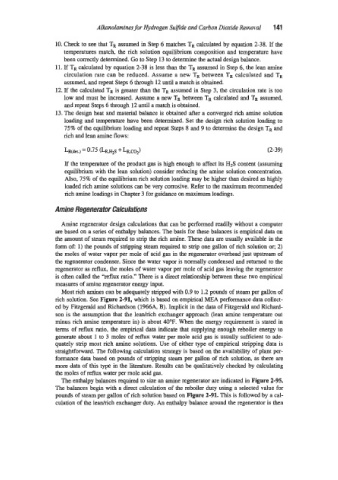
                                                                                (2-39)

                    If the temperature of the product gas is high enough to affect its HIS content (assuming
                    equilibrium with the lean solution) consider reducing the amine solution concentration.
                    Also, 75% of the equilibrium rich solution loading may be higher than desired as highly
                    loaded rich amine solutions can be very corrosive. Refer to the maximum recommended
                    rich amine loadings in Chapter 3 for guidance on maximum loadings.

                  Amine Regenerator Calculations

                   Amine regenerator design calculations that can be performed readily without a computer
                  are based on a series of enthalpy balances. The basis for these balances is empirical data on
                  the amount of  steam required to strip the rich amine. These data are usually available in the
                  form of: 1) the pounds of stripping steam required to strip one gallon of rich solution or; 2)
                  the moles of water vapor per mole of acid gas in the regenerator overhead just upstream of
                  the regenerator condenser. Since the water vapor is normally condensed and returned to the
                  regenerator as reflux, the moles of water vapor per mole of acid gas leaving the regenerator
                  is often called the ”reflux ratio.” There is a direct relationship between these two empirical
                  measures of amine regenerator energy input.
                   Most rich amines can be adequately stripped with 0.9 to 1.2 pounds of steam per gallon of
                  rich solution. See Figure 2-91,  which is based on empirical MEA performance data collect-
                  ed by Fitzgerald and Richardson (1966A, B). Implicit in the data of Fitzgerald and Richard-
                  son is the assumption that the leadrich exchanger approach (lean amine temperature out
                  minus rich amine temperature in) is about 40°F. When the energy requirement is stated in
                  terms of reflux ratio, the empirical data indicate that supplying enough reboiler energy to
                  generate about 1 to 3 moles of reflux water per mole acid gas is usually  sufficient to ade-
                  quately strip most rich amine solutions. Use  of  either type of  empirical stripping data is
                  straightforward. The following calculation strategy is based on the availability of plant per-
                  formance data based on pounds  of  stripping steam per gallon of  rich solution, as there are
                  more data of  this type in the literature. Results can be qualitatively checked by  calculating
                  the moles of reflux water per mole acid gas.
                   The enthalpy balances required to size an amine regenerator are indicated in Figure 2-95.
                  The balances begin with a direct calculation of the reboiler duty using a selected value for
                  pounds of steam per gallon of rich solution based on Figure 2-91.  This is followed by a cal-
                  culation of the ledrich exchanger duty. An enthalpy balance around the regenerator is then

