


Page 148 - Gas Purification 5E
P. 148
Alkanolaniines for Hvdrogen .%&de  and Carbon Dioxide Removal   137


                                               Table 2-20
                            Nomenclature for Simplified Design Procedure Equations

                    C,  = Heat capacity, Btu/(lb)("F)   T = Temperature,"F
                     h = Latent heat of water vapor, Btdlb   W =Mass flow, total, Ibh
                     L = Solution loading, mole acid gad   W' = Mass flow, dry basis, lbhr
                        mole amine
                    M = Gas flow rate, total, mol&   Subscripts:
                    M'  = Gas flow rate, dry basis, mole/hr   A = Acid gas stream at reflux drum outlet
                  MW = Molecular weight, lb          AG = Acid gas
                     P = Pressure or partial pressure, psia   B = Solution at regenerator bottom
                    PO = Equilibrium vapor pressure over a   C = Stripper overhead condensate
                        solution, psia                F = Feed gas entering absorber
                   QRx = Total heat of reaction, Btu/hr   L = Lean solution entering absorber
                   QRc = Regenerator condenser duty. Btu/hr   LX = Lean solution exiting leadrich heat
                   Qm = Ledrich heat exchanger duty,     exchanger
                        Btu/hr                        P = Product gas leaving absorber
                   QRE = Reboiler duty, Btu/hr        R = Rich solution leaving absorber
                    R = Acid gas ratio in feed gas, mole   REF = Reference value
                        C02/mole  H,S                SO = Acid gas stream at stripper overhead


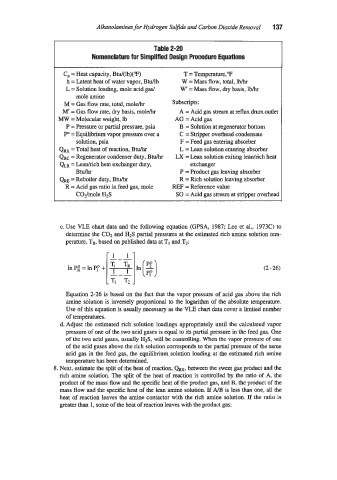
                   c. Use VLE chart data and the following equation (GPSA? 1987; Lee et al.,  1973C) to
                     determine the C02 and H2S partial pressures at the estimated rich amine solution tem-
                    perature, TR. based on published data at TI and T2:


                                                                               (2 - 26)


                     Equation 2-26 is based on the fact that the vapor pressure of  acid gas 2bove the rich
                     amine solution is inversely proportional to the logarithm of  the absolute temperature.
                     Use of this equation is usually necessary as the VLE chart data cover a limited number
                     of temperatures.
                   d. Adjust the estimated rich solution loadings appropriately until the calculated vapor
                     pressure of one of the two acid gases is equal to its partial pressure in the feed gas. One
                     of the two acid gases, usually H2S, will be controlling. When the vapor pressure of one
                     of the acid gases above the rich solution corresponds to the partial pressure of the same
                     acid gas in the feed gas, the equilibrium solution loading at the estimated rich amine
                     temperature has been determined.
                 8. Next, estimate the split of the heat of reaction, &.  between the sweet gas product and the
                   rich amine solution. The split of  the heat of  reaction is controlled by the ratio of  A, the
                   product of the mass flow and the specific heat of the product gas, and B, the product of the
                   mass flow and the specific heat of the lean amine solution. If A/B is less than one, all the
                   heat of reaction leaves the amine contactor with the rich amine solution. If  the ratio is
                   greater than 1, some of the heat of reaction leaves with the product gas:

