


Page 149 - Gas Purification 5E
P. 149
130    Gas Purijication


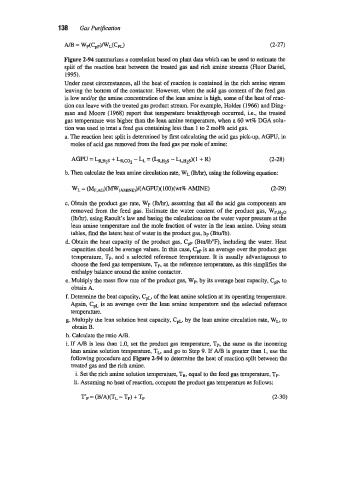
                                                                                 (2-27)
                    Figure 2-94 summarizes a correlation based on plant data which can be used to estimate the
                    split of the reaction heat between the treated gas and rich amine streams (Fluor Daniel,
                    1995).
                    Under most circumstances, all the heat of reaction is contained in the rich amine stream
                    leaving the bottom of the contactor. However, when the acid gas content of the feed gas
                    is low and/or the amine concentration of the lean amine is high, some of the heat of reac-
                    tion can leave with the treated gas product stream. For example, Holder (1966) and Ding-
                    man  and Moore (1968) report that temperature breakthrough occurred, Le.,  the treated
                    gas temperature was higher than the lean amine temperature, when a 60 wt% DGA solu-
                    tion was used to treat a feed gas containing less than 1 to 2 mol% acid gas.
                    a. The reaction heat split is determined by first calculating the acid gas pick-up, AGPU, in
                      moles of acid gas removed from the feed gas per mole of amine:

                                                                                 (2-28)
                    b. Then calculate the lean amine circulation rate, WL (lbh), using the following equation:


                    c. Obtain the product gas rate, Wp  (lbh), assuming that all the acid gas components are
                      removed from the feed gas. Estimate the water content of  the product gas, WP.~,o
                      (lbh)? using Raoult's law and basing the calculations on the water vapor pressure at the
                      lean amine temperature and the mole fraction of water in the lean amine. Using steam
                      tables, find the latent heat of water in the product gas, hp (Btdlb).
                    d. Obtain the heat capacity of  the product gas, Cpp (Btu/lb"F), including the water. Heat
                      capacities should be average values. In this case, Cpp is an average over the product gas
                      temperature, Tp, and a selected reference temperature. It is usually advantageous to
                      choose the feed gas temperature, TF, as the reference temperature, as this simplifies the
                      enthalpy balance around the amine contactor.
                     e. Multiply the mass flow rate of the product gas, Wp, by its average heat capacity, Cpp. to
                      obtain A.
                     f. Determine the heat capacity, CpL, of the lean amine solution at its operating temperature.
                      Again, CpL is an  average over the lean amine temperature and the selected reference
                      temperature.
                     g. Multiply the lean solution heat capacity, Cp~, by the lean amine circulation rate, WL, to
                      obtain B.
                     h. Calculate the ratio AB.
                     i. If  AB is less than 1.0, set the product gas temperature, Tp, the same as the incoming
                      lean amine solution temperature, TL, and go to Step 9. If AIB is greater than  1, use the
                      following procedure and Figure 2-94 to determine the heat of reaction split between the
                      treated gas and the rich amine.
                       i. Set the rich amine solution temperature, TR. equal to the feed gas temperature, TF.
                       ii. Assuming no heat of reaction, compute the product gas temperature as follows:
                                         +
                         Tp = (B/A)(T, - TF) TF                                   (2-30)

