


Page 152 - Gas Purification 5E
P. 152
140   Gas Purification


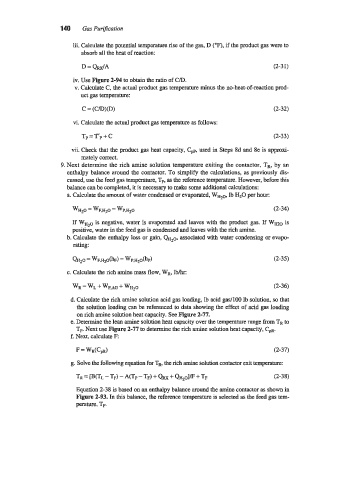
                       iii. Calculate the potential temperature rise of the gas, D (“F), if the product gas were to
                         absorb all the heat of reaction:

                         D = Q&A                                                  (2-3 1)
                       iv. Use Figure 2-94 to obtain the ratio of C/D.
                       v. Calculate C, the actual product gas temperature minus the no-heat-of-reaction  pmd-
                         uct gas temperature:
                         C = (C/D)(D)                                             (2-32)

                       vi. Calculate the actual product gas temperature as follows:
                         Tp = T‘p  + C                                            (2-33)

                      vii. Check that the product gas heat capacity, qp, used in Steps 8d and 8e is approxi-
                         mately correct.
                   9. Next determine the rich amine solution temperature exiting the contactor, TR, by  an
                     enthalpy balance around the contactor. To simplify the calculations, as previously dis-
                     cussed, use the feed gas temperature,  TF, as the reference temperature. However, before this
                     balance can be completed, it is necessary to make some additional calculations:
                     a. Calculate the amount of water condensed or evaporated,  WH20, lb HO per hour:

                      WH~O = wF.HzO  - wP.H20                                     (2-34)
                       If WH2.  is negative, water is evaporated and leaves with the product gas. If  WH20 is
                       positive, water in the feed gas is condensed and leaves with the rich amine.
                     b. Calculate the enthalpy loss or gain, QH20,  associated with water condensing or evapo-
                       rating:


                       QH~O = wF.H2001F)  - wP.H20(hP)                            (2-35)
                     c. Calculate the rich amine mass flow, W,,  lbk
                       WR = WL + WFAG + WH~O                                      (2-36)
                      d. Calculate the rich amine solution acid gas loading, lb acid gad100 lb solution, so that
                        the solution loading can be referenced to data showing the effect of acid gas loading
                        on rich amine solution heat capacity. See Figure 2-77.
                      e. Determine the lean amine solution heat capacity over the temperature range from TR to
                        TF Next use Figure 2-77 to determine the rich amine solution heat capacity, CpR.
                      f. Next, calculate F


                      g. Solve the following equation for TR, the rich amine solution contactor exit temperature:


                        Equation 2-38 is based on an enthalpy balance around the amine contactor as shown in
                        Figure 2-93.  In this balance, the reference temperature is selected as the feed gas tem-
                        perature. TF

