


Page 155 - Gas Purification 5E
P. 155
Alkanolamines for Hydrogen Sulfide and Carbon Dioxide Reinoval   143


                   After the regenerator pressure profile and the reflux drum pressure are established, the
                 reflux drum temperature, TA4? is fixed. If the acid gas is to be fed to a Claw sulfur plant. the
                 reflux drum temperature should be minimized consistent with the available cooling medium
                 temperature since water contained in the acid gas is detrimental to sulfur plant performance.
                 For air cooling, an approach of 20°F is common, while a typical approach for cooling water
                 would be in the range of  10°F.
                   After fixing the pressure profile and key temperatures, the required reboiler and ledrich
                 exchanger duties are calculated. The reboiler duty, QRE, is calculated directly from the strip-
                 ping steam requirement obtained fmm Figure 2-91 and the rich amine flow determined in
                 the absorber design calculation outlined earlier. The steam latent heat is calculated based on
                 the temperature/pressure conditions of condensing steam in the reboiler. This temperature is
                 fixed by  either the maximum allowable steam operating temperature or a minimum 20’F
                 reboiler approach temperature (steam saturation temperature minus reboiler outlet tempera-
                 turej. X maximum steam operating temperature of 300°F has been recommended by  several
                 authors. See the discussion of recommended maximum steam and hot oil operating tempera-
                 tures in Chapter 3.
                   In determining the ledrich exchanger duty:  QLR,  it is first necessary to determine the
                 regenerator bottoms temperature, Tg. This temperature is fixed by the. lean amine composi-
                 tion, the lean amine type,  and the regenerator pressure profile. As previously noted, a pres-
                 sure drop of  about 5  psi from the reflux drum to the stripper bottoms should be allowed.
                 Available aqueous amine solution vapor pressure data are then used to determine the stripper
                 bottoms temperature, TB. See Figures 2-56,2-57,2-58,2-59,  2-60,  and 2-61 for vapor pres-
                 sure/temperature data for MEA, DEA, DGA, TEA, DPAI and MDEA, respectively.
                   After determining the regenerator bottoms temperature, the temperature of the lean amine
                 leaving the ledrich exchanger is estimated. A commonly used rule of thumb is that the dif-
                 ference between the lean amine outlet temperature,  TLXI and the rich amine inlet tempera-
                 ture, TR.  should be about 40°F. In addition, the rich amine outlet temperature should not be
                 higher than about 210 to 220°F as excess heat recovery contributes little towards amine strip-
                 ping (i.e., above a certain temperature, recovered heat generates steam at the feed tray, which
                 is much less effective for amine stripping than steam generated by the reboiler). Having set
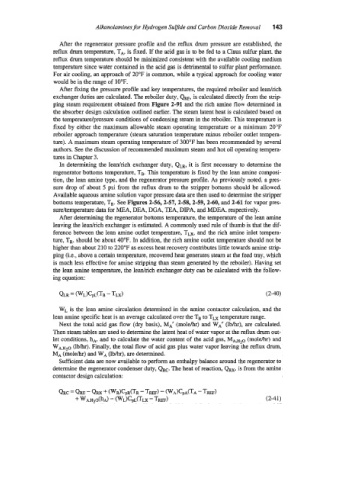
                 the lean amine temperature, the ledrich exchanger duty can be calculated with the follow-
                 ing equation:


                   WL is the lean amine circulation determined in the amine contactor calculation, and the
                 lean amine specific heat is an average calculated over the Tg to Tu  temperature range.
                   Next the total acid gas flow (dry basis), MA‘ (moleh) and W,’  (lbhr), are calculated.
                 Then steam tables are used to determine the latent heat of water vapor at the reflux drum out-
                 let conditions, hA4, and to calculate the water content of the acid gas, MA;H2O (mole/hr) and
                 WA,lo  (lbhr). Finally, the total flow of  acid gas plus water vapor leaving the reflux drum?
                 MA (molehr) and WA (lbk)? are determined.
                   Sufficient data are now available to perform an enthalpy balance around the regenerator to
                 determine the regenerator condenser duty, QRC. The heat of reaction, QRX. is from the amine
                 contactor design calculation:


                                                                               (2-41 j

