


Page 207 - Gas Purification 5E
P. 207
Mechanical Design and Operation of Alkanolamine Plants   193

                   Figure 3-2 shows that the corrosion rate at any given partial pressure increases with tem-
                 perature at moderate temperatures, but reaches a maximum as the temperature is further
                 increased. De Waard and Lotz (1993) attribute this effect to the formation of a more protec-
                 tive film, either FeC03 or Fe304, at higher temperatures. The reduction of comsion rate at
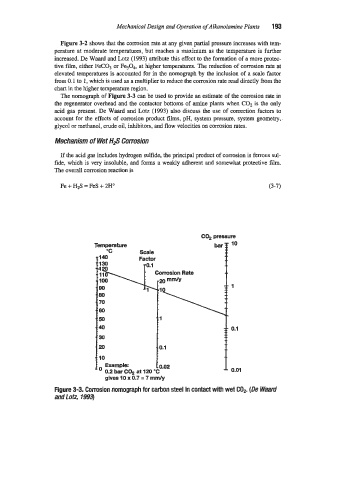
                 elevated temperatures is accounted for in the nomograph by the inclusion of a scale factor
                 from 0.1 to 1, which is used as a multiplier to reduce the corrosion rate read directly from the
                 chart in the higher temperature region.
                   The nomograph of Figure 3-3 can be used to provide an estimate of the corrosion rate in
                 the regenerator  overhead and the contactor bottoms of  amine plants when COz is the only
                 acid gas present. De Waard and Lotz  (1993) also discuss the use of correction factors to
                 account for the effects of  corrosion product flms, pH,  system pressure, system geometry,
                 glycol or methanol, crude oil, inhibitors, and flow velocities on umusion rates.
                 Mechanism of Wet Hfi Corrosion

                   If the acid gas includes hydrogen sultide, the principal product of corrosion is ferrous sul-
                 fide, which is vay insoluble, and fom a weakly adherent and somewhat protective film.
                 The overall corrosion reaction is

                   Fe + H2S = FeS + 2H"                                          (3-7)


                 Figure 3-3. Corrosion nomograph for cahon steel in contact with wet COP. (De Waard
                 and f otz, 1993)

