


Page 208 - Gas Purification 5E
P. 208
194    GasPuriJcation


                     Iron sulfide is more protective than iron carbonate, and, if the acid gas contains sufficient
                   HzS, a protective sulfide film can be formed. If contaminants which disrupt this iron sulfide
                   film are not present, and if the mechanical design minimizes erosion-corrosion, wet acid cor-
                   rosion of exposed carbon steel surfaces will be limited. On the other hand, if the gas is pre-
                   dominantly COz. wet acid gas corrosion will occur and protective measures are required. As
                   might be expected, there is disagreement on the exact COz/HzS ratio above which protective
                   measures are required. API Recommended Practice 945 suggests that wet COz corrosion
                   occurs when the acid gas contains 95% or more COz (API, 1990).

                   Mechanism of Wet Acid Gas Corrosion Due to NU3 and HCN

                     In refineries, the amine regenerator overhead system is often affected by wet acid gas cor-
                   rosion due to the combined presence of ammonia, COz, and HzS. Wet acid gas corrosion of
                   the overhead system is accelerated if HCN is also present (Ehmke 1981A, B). In these cir-
                   cumstances, wet acid gas corrosion due to HzS and COz can occur when the COz content of
                   the acid gas is less than 90%. In fact, substantial corrosion can occur in the total absence of
                   COz if sufficient HCN and ammonia are present.
                     Ammonia and HCN are found in gas streams from delayed cokers, visbreakers, and fluid
                   catalytic cracking units (FCCUs). Ammonia, HCN, and HzS are also produced during
                   hydrotreating and hydrocracking operations. When gases from these units are treated, the
                   ammonia is readily absorbed by aqueous alkanolamine solutions. HCN, which is a weak acid
                   and very water-soluble, is chemically absorbed by  alkanolamine solutions and is released,
                   along with the absorbed ammonia, in the amine regenerator.
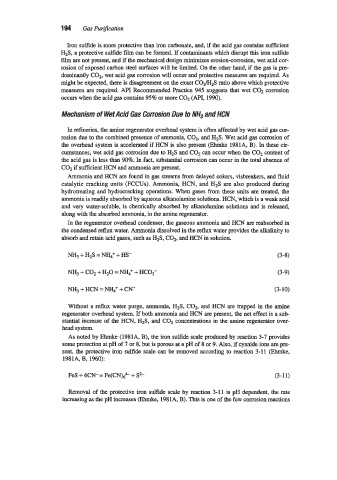
                     In the regenerator overhead condenser, the gaseous ammonia and HCN are. reabsorbed in
                   the condensed reflux water. Ammonia dissolved in the reflux water provides the alkalinity to
                   absorb and retain acid gases, such as HzS, COz, and HCN in solution.


                     NH3 + COz + HzO = N&+ + HC03-                                 (3-9)
                                    +
                     NH3 + HCN = m+ CN-                                           (3-10)

                     Without a reflux water purge, ammonia,  H2S, COz, and HCN ae trapped in the amine
                   regenerator overhead system. If both ammonia and HCN are present, the net effect is a sub-
                   stantial increase of the HCN, HzS, and COz concentrations in the amine regenerator over-
                   head system.
                     As noted by Ehmke (1981A, B), the iron sulfide scale produced by reaction 3-7 provides
                   some protection at pH of 7 or 8, but is porous at a pH of 8 or 9. Also, if cyanide ions are pre-
                   sent, the protective iron sulfide scale can be removed according to reaction 3-11 (Ehmke,
                    1981A, B, 1960):


                     FeS + 6CN- = Fe(CN)64- + Sz-                                 (3-1 1)

                     Removal of  the protective iron sulfide scale by  reaction 3-11 is pH dependent, the rate
                   increasing as the pH increases (Ehmke, 1981A, B). This is one of the few corrosion reactions

