


Page 212 - Gas Purification 5E
P. 212
198    Gas Purijkation


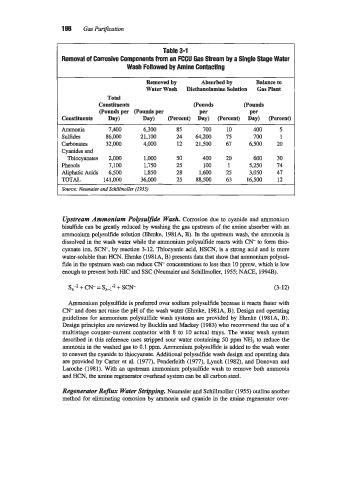
                                                 Table 3-1
                   Removal of Corrosive Components from an FCCU Gas Weam by a Single Stage Water
                                       Wash Followed by Amine Contacting

                                            Removed by       Absorbed by     Balance to
                                            Water Wash   Diethanolamine Solution   Gas Plant
                                 Total
                              Constituents                (Pounds        (Pounds
                              (Pounds per  (Pounds per      Per            Per
                   Constituents   Day)     Day)    (Percent)  Day)  (Percent)  Day)   (Percent)

                   Ammonia       7,400      6,300    85      700    10      400     5
                   Sulfides     86,000     21,100    24    64,200   75      700     1
                   Carbonates   32,000      4,000    12    21,500   67     6,500   20
                   Cyanides and
                     Thiocyanates   2,000   1  ,OOo   50     400    20      600    30
                   Phenols       7,100      1,750    25      100     1     5,250   74
                   Aliphatic Acids   6,500   1,850   28     1,600   25     3,050   47
                   TOTAL        141,000    36,000    25    88,500   63    16,500   12
                   Source: Neumaier and Schillmoller (1955)


                    Upstream Ammonium Polysulfide Wash. Corrosion due to cyanide and ammonium
                   bisulfide can be greatly reduced by washing the gas upstream of the amine absorber with an
                    ammonium polysulfide solution (Ehmke, 1981A, B). In the upstream wash, the ammonia is
                    dissolved in the wash water while the ammonium polysulfde reacts with CN-  to form thio-
                   cyanate ion, SCN-,  by reaction  3-12. Thiocyanic acid, HSCN, is a stsong acid and is more
                   water-soluble than HCN. Ehmlre (1981A, B) presents data that show that ammonium polysul-
                    fide in the upstream wash can reduce CN- concentrations to less than 10 ppmw, which is low
                    enough to prevent both HIC and SSC (Neumaier and Schillmoller, 1955; NACE, 1994B).

                     Sx-z + CN-= S,1-2+   SCN-                                    (3-12)
                     Ammonium polysulfide is preferred over sodium polysulfide because it reacts faster with
                    CN- and does not raise the pH of the wash water (Ehmke, 1981A, B). Design and operating
                    guidelines for ammonium polysulfide wash  systems are provided by Ehmke (1981A, B).
                    Design principles are reviewed by Bucklin and Mackey (1983) who recommend the use of a
                    multistage counter-current contactor with 8 to  10 actual trays. The water wash system
                    described in this reference uses stripped sour water containing 50 ppm NH3 to reduce the
                    ammonia in the washed gas to 0.1 ppm. Ammonium polysulfde is added to the wash water
                    to convert the cyanide to thiocyanate. Additional polysulfide wash design and operating data
                    are provided by  Carter et al.  (1977), Penderleith (1977), Lynch (1982), and Donovan and
                    Laroche (1981). With an upstream ammonium polysulfide wash to remove both ammonia
                    and HCN, the amine regenerator overhead system can be all carbon steel.

                    Regenerafor Reflux Wafer Stripping. Neumaier and Schillmoller (1955) outline another
                    method for eliminating corrosion by  ammonia and cyanide in the amine regenerator over-

