


Page 214 - Gas Purification 5E
P. 214
200    Gas PuniJication


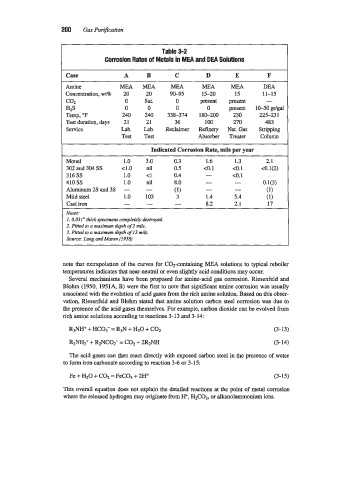
                                                 Table 3-2
                                Corrosion Rates of Metals in MEA and DEA Solutions

                     Case             A      B       C        D        E         P
                      ~~~        ~
                     Amine           MEA    MEA     MEA      MEA      MEA      DEA
                     Concentration, wt%   20   20   90-95    15-20     15      11-15
                     COZ              0     Sat.     0       present   present   -
                     HZS              0      0       0         0     present   10-50  gr/gal
                     Temp, "F        240    240    338-374   180-200   230    225-23  1
                     Test duration, days   21   21   36       100     270       483
                     Service         Lab.   Lab.   Reclaimer   Refinery   Nat. Gas   Stripping
                                     Test   Test            Absorber   Treater   Column
                                              Indicated Corrosion Rate, mils per year
                     Monel            1.0   3.0      0.3      1.6      1.3      2.1
                     302 and 304 SS   4.0    nil     0.5      <o. 1   co. 1    <0.1(2)
                     316 SS           1.0    <1      0.4      -       co. 1
                     410 SS           1.0    nil     8.0      -        -       0.1(3)
                     Aluminum 2s and 3s   -   -      (1)      -        -        (1)
                     Mild steel       1.0   103       3       1.4      5.4      (1)
                     Cast iron        -      -       -        8.2      2.1       17
                     Notes:
                     1. 0.031" thick specimens completely destroyed.
                     2. Pitted to a maximum depth of 2 mils.
                     3. Pitted to a maximum depth of 13 mils.
                     Source: Lang and Mason (1958)


                    note that extrapolation of the curves for COz-containing MEA solutions to typical reboiler
                    temperatures indicates that near-neutral or even slightly acid conditions may occur.
                      Several mechanisms have been proposed for amine-acid gas corrosion. Riesenfeld and
                    Blohm (1950, 1951A, B) were the first to note that significant amine corrosion was usually
                    associated with the evolution of acid gases from the rich amine solution. Based on this obser-
                    vation, Riesenfeld and Blohm stated that amine solution carbon steel corrosion was due to
                    the presence of the acid gases themselves. For example, carbon dioxide can be evolved from
                    rich amine solutions according to reactions 3-13 and 3-14:
                      R3NH+  + HC03- = R3N + HzO + COz                             (3-13)

                      RzNHZ+ + RzNCOz- = COZ + 2RzNH                               (3-14)
                      The acid gases can then react directly with exposed carbon steel in the presence of water
                    to form iron carbonate according to reaction 3-6 or 3-15:
                      Fe + H20 + COz = FeC03 + 2H"                                 (3-15)

                    This overall equation does not explain the detailed reactions at the point of  metal corrosion
                    where the released hydrogen may originate from H+, H2C03, or alkanolammoniurn ions.

