


Page 216 - Gas Purification 5E
P. 216
202   Gas PuriiJication


                   heat-stable salts with regard to stability, the carbamate may  also act like other heat-stable
                   salts with regard to corrosivity.
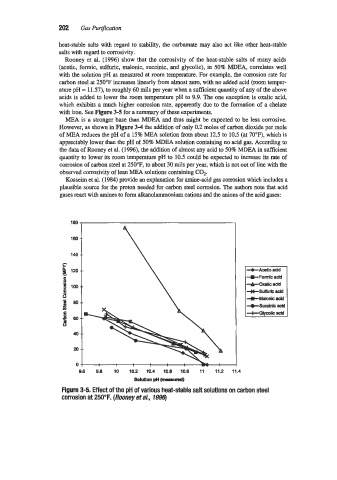
                    Rooney et al. (1996) show that the corrosivity of  the heat-stable salts of  many acids
                   (acetic, formic, sulfuric, malonic, succinic, and glycolic), in 50% MDEA, correlates well
                   with the solution pH as measured at mom temperature. For example, the corrosion rate for
                   carbon steel at 250°F increases linearly from almost zero, with no added acid (room temper-
                   ature pH = 11.57), to roughly 60 mils per year when a sufficient quantity of any of the above
                   acids is added to lower the room temperature pH to 9.9.  The one exception is oxalic acid,
                   which exhibits a much higher corrosion rate, apparently due to the formation of  a chelate
                   with iron. See Figure 3-5 for a summary of these experiments.
                    MEA is a stronger base than MDEA and thus might be expected to be less corrosive.
                   However, as shown in Figure 3-4 the addition of only 0.2 moles of carbon dioxide per mole
                   of MEA reduces the pH of a 15% MEA solution from about 12.5 to 10.5 (at 70°F), which is
                   appreciably lower than the pH of 50% h4DEA solution containing no acid gas. According to
                   the data of Rooney et al. (1996), the addition of almost any acid to 50% MDEA in sufficient
                   quantity to lower its room temperature pH to 10.5 could be expected to increase its rate of
                   corrosion of carbon steel at 250"F, to about 30 mils per year, which is not out of line with the
                   observed corrosivity of lean MEA solutions containing COz.
                     Kosseim et al. (1984) provide an explanation for amine-acid gas corrosion which includes a
                   plausible source for the proton needed for carbon steel corrosion. The authors note that acid
                   gases react with amines to form alkanolammonium cations and the anions of the acid gases:


                                       \


                      140 lsi

                                                                          +Aceticadd
                                                                          +Formic   acid
                                                                          4Oxali acld
                                                                          +Sulfuric   acid
                                                                          +Malonic   acid
                                                                          +Succinic   acid
                                                                          +Gtycollc   acid


                         9.6   9.8   10   10.2   10.4   10.8   10.8   I1   11.2   11.4
                                         solution pH (me8Sund)
                   Figure 3-5.  Effect of the pH of various heat-stable salt solutions on carbon steel
                   corrosion at 250°F. (Rooney eta/., 7996)

