


Page 218 - Gas Purification 5E
P. 218
204   GaspUrification


                                 150   160   170   180   190   200   210   220   230
                                          Comsiin  Loop Tmpemme, T

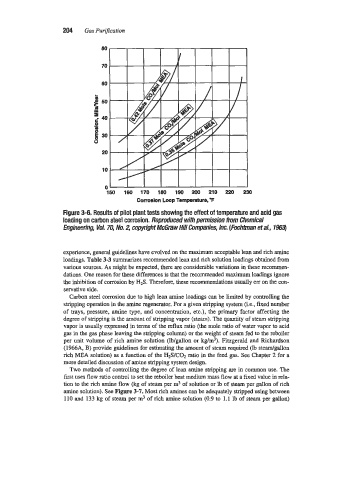
                    Figure 3-6. Results of pilot plant tests showing the effect of temperature and acid gas
                    loading on carbon steel corrosion. Reproduced witfi permission from Memica/
                    Engineering, Vol. 70, No. 2, mpynghf McGraw Hill Companies, Inc. (hxhtman et al., 1-


                    experience, general guidelines have evolved on the maximum acceptable lean and rich amine
                    loadings. Table 3-3 summarizes recommended lean and rich solution loadings obtained from
                    various sources. As might be expected, here are considerable variations in these recommen-
                    dations. One reason for these differences is that the recommended maximum loadings ignore
                    the inhibition of corrosion by H2S. Therefore, these recommendations usually err on the con-
                    servative side.
                      Carbon steel corrosion due to high lean amine loadings can be limited by controlling the
                    stripping operation in the amine regenerator. For a given stripping system (Le.,  fmed number
                    of trays, pressure, amine type, and concentration, etc.),  the primary factor affecting the
                    degree of stripping is the amount of stripping vapor (steam). The quantity of steam stripping
                    vapor is usually expressed in terms of the reflux ratio (the mole ratio of water vapor to acid
                    gas in the gas phase leaving the stripping column) or the weight of steam fed to the reboiler
                    per unit volume of rich amine solution (lb/gallon or kg/m3). Fitzgerald and Richardson
                    (1966A, B) provide guidelines for estimating the amount of  steam required (lb stedgallon
                    rich MEA solution) as a function of the H2S/C02 ratio in the feed gas. See Chapter 2 for a
                    more detailed discussion of amine stripping system design.
                      Two methods of  controlling the degree of lean amine stripping are in common use. The
                    first uses flow ratio control to set the reboiler heat medium mass flow at a lixed value in rela-
                    tion to the rich amine flow (kg of  steam per m3 of solution or lb of steam per gallon of rich
                    amine solution). See Figure 3-7. Most rich amines can be adequately stripped using between
                    110 and  133 kg of  steam per m3 of rich amine solution (0.9 to 1.1 lb of  steam per gallon)

