


Page 219 - Gas Purification 5E
P. 219
Mechanical Design and Operation of Alhnolamine Plants   205


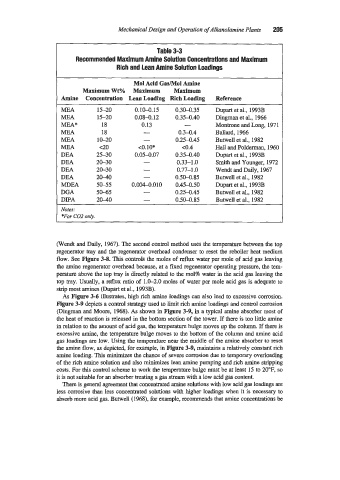
                                                Table 3-3
                        Recommended Maximum Amine Solution Concentrations and Maximum
                                    Rich and Lean Amine Solution Loadings

                                         Mol Acid GaslMol Amine
                          Maximum Wt%  Maximum       Maximum
                   Amine  Concentration  Lean Loading  Rich Loading   Reference
                   MEA        15-20      0.10-0.15   0.30-0.35   Dupart et al., 1993B
                   MEA        15-20      0.08-0. 12   0.35-0.40   Dingman et al.,  1966
                   MEA*        18          0.13         -        Montrone and Long, 197 1
                   MEA         18           -         0.3-0.4    Ballard, 1966
                   MEA        10-20         -        0.25-0.45   Butwell et al., 1982
                   MEA         e20        <o. 10*      c0.4      Hall and Polderman, 1960
                   DEA        25-30      0.05-0.07   0.35-0.40   Dupart et al., 1993B
                   DEA        20-30         -         0.33-1.0   Smith and Younger, 1972
                   DEA        20-30         -         0.77-1 .O   Wendt and Daily, 1967
                   DEA        2040          -        0.50-0.85   Butwell et al., 1982
                   MDEA       50-55     0.004-0.010   0.45-0.50   Dupart et al., 1993B
                   DGA        50-65         -        0.25-0.45   Butwell et al., 1982
                   DIPA       2040          -        0.50-0.85   Butwell et al., 1982
                   Notes:
                   *For C02 only.


                  (Wendt and Daily,  1967). The second control method uses the temperature between the top
                  regenerator tray and the regenerator overhead condenser to reset the reboiler heat medium
                  flow. See Figure 3-8. This controls the moles of reflux water per mole of acid gas leaving
                  the amine regenerator overhead because, at a fixed regenerator operating pressure, the tem-
                  perature above the top tray is directly related to the mol% water in the acid gas leaving the
                  top tray. Usually, a reflux ratio of  1.0-2.0  moles of water per mole acid gas is adequate to
                  strip most amines (Dupart et al., 1993B).
                    As Figure 3-6 illustrates, high rich amine loadings can also lead to excessive corrosion.
                  Figure 3-9 depicts a control strategy used to limit rich amine loadings and control corrosion
                  (Dingman and Moore, 1968). As shown in Figure 3-9, in a typical amine absorber most of
                  the heat of reaction is released in the bottom section of the tower. If there is too little amine
                  in relation to the amount of acid gas, the temperature bulge moves up the column. If there is
                  excessive amine, the temperature bulge moves to the bottom of the column and amine acid
                  gas loadings are low. Using the temperatm near the middle of the amine absorber to reset
                  the amine flow, as depicted, for example, in Figure 3-9, maintains a relatively constant rich
                  amine loading. This minimizes the chance of severe corrosion due to temporary overloading
                  of the rich amine solution and also minimizes lean amine pumping and rich amine stripping
                  costs. For this control scheme to work the temperature bulge must be at least 15 to 20"F, so
                  it is not suitable for an absorber treating a gas stream with a low acid gas content.
                    There is general agreement that concentrated amine solutions with low acid gas loadings are
                  less corrosive than less concentrated solutions with higher loadings when it is necessary to
                  absorb more acid gas. Butwell (1968), for example, recommends that amine concentrations be

