


Page 215 - Gas Purification 5E
P. 215
Mechanical Design and Operation of Alkanolamine Plants   201


                          I
                          n


                                             TEMPERATURE  OF
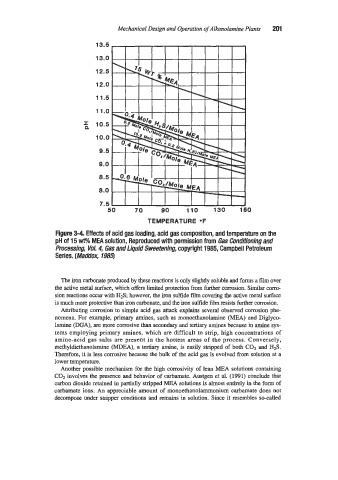
                  Figure 3-4. Effects of acid gas loading, acid gas composition, and temperature on the
                 pH of 15 WO MEA solution, Reproduced with permission from Gas Conditioning and
                  Processing, VoL 4, Gas and Liquid Sweetening, copyright 1985, Campbell Petroleum
                 Series. (Maddox, 1985)


                   The iron carbonate produced by these reactions is only slightly soluble and forms a film over
                 the active metal surface, which offers limited protection from further corrosion. Similar corro-
                 sion reactions occur with H2S; however, the iron sulfide film covering the active metal surface
                 is much more protective than iron carbonate, and the iron sulfide film resists further corrosion.
                   Attributing corrosion to simple acid gas attack explains several observed corrosion phe-
                 nomena. For example, primary amines, such as monoethanolamine (MEA) and Diglyco-
                 lamine (DGA), are more corrosive than secondary and tertiary amines because in amine sys-
                 tems employing primary  amines, which  are difficult  to strip, high concentrations  of
                 amine-acid gas salts are present in the hottest areas of  the process. Conversely,
                 methyldiethanolamine (MDEA), a tertiary amine, is easily stripped of  both C02 and H2S.
                 Therefore, it is less corrosive because the bulk of the acid gas is evolved from solution at a
                 lower temperature.
                   Another possible mechanism for the high corrosivity of  lean MEA solutions containing
                 COz involves the presence and behavior of  carbamate. Austgen et al. (1991) conclude that
                 carbon dioxide retained in partially stripped MEA solutions is almost entirely in the form of
                 carbamate ions. An  appreciable amount of  monoethanolammonium carbamate does not
                 decompose under stripper conditions and remains in solution. Since it resembles so-called

