


Page 179 - gas transport in porous media
P. 179
Chapter 9: Unstable Gas Flow in Fractures
                                         32
                                                                   upper path  220         173
                                                                   lower path  180
                                       Pressure (psia)        Gas inlet            Pressure (kPa)
                                         26
                                                              Liquid inlet
                                         20
                                                              Gas outlet      140
                                                              Liquid outlet
                                         14                                   100
                                         348.9       349.8      350.7       351.6
                                                         Time (hr)
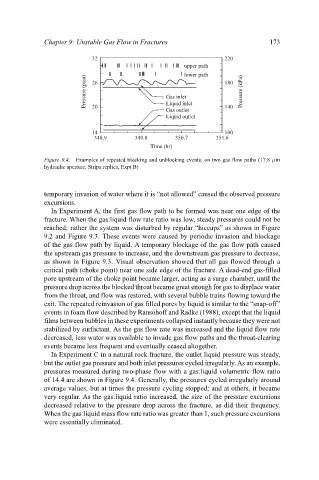
                           Figure 9.4.  Examples of repeated blocking and unblocking events, on two gas flow paths (17.8 µm
                           hydraulic aperture, Stripa replica, Expt B)


                           temporary invasion of water where it is “not allowed” caused the observed pressure
                           excursions.
                             In Experiment A, the first gas flow path to be formed was near one edge of the
                           fracture. When the gas:liquid flow rate ratio was low, steady pressures could not be
                           reached; rather the system was disturbed by regular “hiccups” as shown in Figure
                           9.2 and Figure 9.3. These events were caused by periodic invasion and blockage
                           of the gas flow path by liquid. A temporary blockage of the gas flow path caused
                           the upstream gas pressure to increase, and the downstream gas pressure to decrease,
                           as shown in Figure 9.3. Visual observation showed that all gas flowed through a
                           critical path (choke point) near one side edge of the fracture. A dead-end gas-filled
                           pore upstream of the choke point became larger, acting as a surge chamber, until the
                           pressure drop across the blocked throat became great enough for gas to displace water
                           from the throat, and flow was restored, with several bubble trains flowing toward the
                           exit. The repeated reinvasion of gas filled pores by liquid is similar to the “snap-off”
                           events in foam flow described by Ransohoff and Radke (1988), except that the liquid
                           films between bubbles in these experiments collapsed instantly because they were not
                           stabilized by surfactant. As the gas flow rate was increased and the liquid flow rate
                           decreased, less water was available to invade gas flow paths and the throat-clearing
                           events became less frequent and eventually ceased altogether.
                             In Experiment C in a natural rock fracture, the outlet liquid pressure was steady,
                           but the outlet gas pressure and both inlet pressures cycled irregularly. As an example,
                           pressures measured during two-phase flow with a gas:liquid volumetric flow ratio
                           of 14.4 are shown in Figure 9.4. Generally, the pressures cycled irregularly around
                           average values, but at times the pressure cycling stopped; and at others, it became
                           very regular. As the gas:liquid ratio increased, the size of the pressure excursions
                           decreased relative to the pressure drop across the fracture, as did their frequency.
                           When the gas:liquid mass flow rate ratio was greater than 1, such pressure excursions
                           were essentially eliminated.

