


Page 182 - gas transport in porous media
P. 182
176
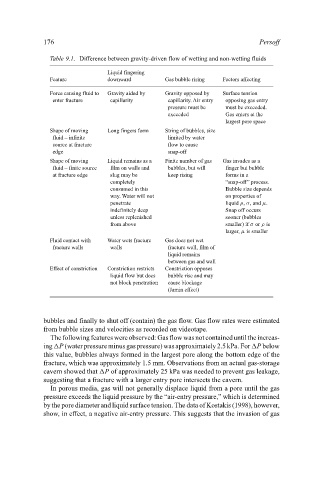
                             Table 9.1. Difference between gravity-driven flow of wetting and non-wetting fluids
                                             Liquid fingering                           Persoff
                             Feature         downward        Gas bubble rising  Factors affecting
                             Force causing fluid to  Gravity aided by  Gravity opposed by  Surface tension
                              enter fracture  capillarity     capillarity. Air entry  opposing gas entry
                                                              pressure must be  must be exceeded.
                                                              exceeded         Gas enters at the
                                                                               largest pore space
                             Shape of moving  Long fingers form  String of bubbles, size
                              fluid – infinite                limited by water
                              source at fracture              flow to cause
                              edge                            snap-off
                             Shape of moving  Liquid remains as a  Finite number of gas  Gas invades as a
                              fluid – finite source  film on walls and  bubbles, but will  finger but bubble
                              at fracture edge  slug may be   keep rising      forms in a
                                              completely                       “snap-off” process.
                                              consumed in this                 Bubble size depends
                                              way. Water will not              on properties of
                                              penetrate                        liquid ρ, σ, and µ.
                                              indefinitely deep                Snap off occurs
                                              unless replenished               sooner (bubbles
                                              from above                       smaller) if σ or ρ is
                                                                               larger, µ is smaller
                             Fluid contact with  Water wets fracture  Gas does not wet
                              fracture walls  walls           fracture wall, film of
                                                              liquid remains
                                                              between gas and wall
                             Effect of constriction  Constriction restricts  Constriction opposes
                                              liquid flow but does  bubble rise and may
                                              not block penetration  cause blockage
                                                              (Jamin effect)


                           bubbles and finally to shut off (contain) the gas flow. Gas flow rates were estimated
                           from bubble sizes and velocities as recorded on videotape.
                             The following features were observed: Gas flow was not contained until the increas-
                           ing P (waterpressureminusgaspressure)wasapproximately2.5kPa. For P below
                           this value, bubbles always formed in the largest pore along the bottom edge of the
                           fracture, which was approximately 1.5 mm. Observations from an actual gas-storage
                           cavern showed that  P of approximately 25 kPa was needed to prevent gas leakage,
                           suggesting that a fracture with a larger entry pore intersects the cavern.
                             In porous media, gas will not generally displace liquid from a pore until the gas
                           pressure exceeds the liquid pressure by the “air-entry pressure,” which is determined
                           by the pore diameter and liquid surface tension. The data of Kostakis (1998), however,
                           show, in effect, a negative air-entry pressure. This suggests that the invasion of gas

