


Page 321 - gas transport in porous media
P. 321
320
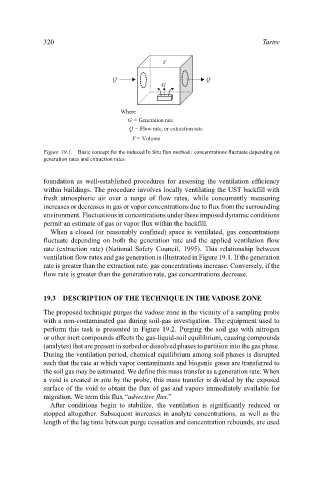
                                                             V                           Tartre
                                               Q                         Q
                                                            G


                                                 Where
                                                   G = Generation rate
                                                   Q = Flow rate, or extraction rate
                                                    V = Volume
                           Figure 19.1.  Basic concept for the induced In Situ flux method : concentrations fluctuate depending on
                           generation rates and extraction rates


                           foundation as well-established procedures for assessing the ventilation efficiency
                           within buildings. The procedure involves locally ventilating the UST backfill with
                           fresh atmospheric air over a range of flow rates, while concurrently measuring
                           increases or decreases in gas or vapor concentrations due to flux from the surrounding
                           environment. Fluctuations in concentrations under these imposed dynamic conditions
                           permit an estimate of gas or vapor flux within the backfill.
                             When a closed (or reasonably confined) space is ventilated, gas concentrations
                           fluctuate depending on both the generation rate and the applied ventilation flow
                           rate (extraction rate) (National Safety Council, 1995). This relationship between
                           ventilation flow rates and gas generation is illustrated in Figure 19.1. If the generation
                           rate is greater than the extraction rate, gas concentrations increase. Conversely, if the
                           flow rate is greater than the generation rate, gas concentrations decrease.


                           19.3  DESCRIPTION OF THE TECHNIQUE IN THE VADOSE ZONE
                           The proposed technique purges the vadose zone in the vicinity of a sampling probe
                           with a non-contaminated gas during soil-gas investigation. The equipment used to
                           perform this task is presented in Figure 19.2. Purging the soil gas with nitrogen
                           or other inert compounds affects the gas-liquid-soil equilibrium, causing compounds
                           (analytes) that are present in sorbed or dissolved phases to partition into the gas phase.
                           During the ventilation period, chemical equilibrium among soil phases is disrupted
                           such that the rate at which vapor contaminants and biogenic gases are transferred to
                           the soil gas may be estimated. We define this mass transfer as a generation rate. When
                           a void is created in situ by the probe, this mass transfer is divided by the exposed
                           surface of the void to obtain the flux of gas and vapors immediately available for
                           migration. We term this flux “advective flux.”
                             After conditions begin to stabilize, the ventilation is significantly reduced or
                           stopped altogether. Subsequent increases in analyte concentrations, as well as the
                           length of the lag time between purge cessation and concentration rebounds, are used

