


Page 339 - gas transport in porous media
P. 339
340
                              Atmospheric conditions - diurnal and seasonal             Phelan
                              Precipitation and runoff
                              Thermal radiation - solar, sky, ground
                              Plant growth and transpiration
                              Wind
                                                                               Ground surface
                                            Vapor-Solid
                                            Partitioning
                                                                                   Soil
                                                                                  particle
                                                                      Liquid-Solid  sorption
                                          Vapor-Liquid
                                  Diffusion  Partitioning  Precipitation  Diffusion  Partitioning

                                         Evaporation/       Evapotranspiration   Solid phase
                                         Condensation                Transformation

                                                                                Microbial
                                                                     and/or Loss
                                                                               degradation/
                                                                                Plant root
                               Vapor phase
                                                        Liquid phase
                                                                                 uptake
                                           Landmine
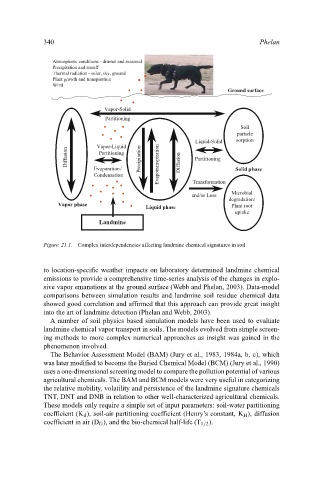
                           Figure 21.1.  Complex interdependencies affecting landmine chemical signatures in soil


                           to location-specific weather impacts on laboratory determined landmine chemical
                           emissions to provide a comprehensive time-series analysis of the changes in explo-
                           sive vapor emanations at the ground surface (Webb and Phelan, 2003). Data-model
                           comparisons between simulation results and landmine soil residue chemical data
                           showed good correlation and affirmed that this approach can provide great insight
                           into the art of landmine detection (Phelan and Webb, 2003).
                             A number of soil physics based simulation models have been used to evaluate
                           landmine chemical vapor transport in soils. The models evolved from simple screen-
                           ing methods to more complex numerical approaches as insight was gained in the
                           phenomenon involved.
                             The Behavior Assessment Model (BAM) (Jury et al., 1983, 1984a, b, c), which
                           was later modified to become the Buried Chemical Model (BCM) (Jury et al., 1990)
                           uses a one-dimensional screening model to compare the pollution potential of various
                           agricultural chemicals. The BAM and BCM models were very useful in categorizing
                           the relative mobility, volatility and persistence of the landmine signature chemicals
                           TNT, DNT and DNB in relation to other well-characterized agricultural chemicals.
                           These models only require a simple set of input parameters: soil-water partitioning
                           coefficient (K d ), soil-air partitioning coefficient (Henry’s constant, K H ), diffusion
                           coefficient in air (D G ), and the bio-chemical half-life (T 1/2 ).

