


Page 344 - gas transport in porous media
P. 344
Chapter 21: Gas Transport Issues in Landmine Detection
                                       1.00E+01          Kabul, Afghanistan                345
                                       1.00E+00
                                       1.00E–01
                                      TNT Gas-phase concentration (ng/L)  1.00E–04
                                       1.00E–02
                                       1.00E–03
                                       1.00E–05
                                       1.00E–06
                                       1.00E–07
                                       1.00E–08
                                       1.00E–09
                                       1.00E–10
                                       1.00E–11
                                       1.00E–12
                                             0    50   100  150   200  250  300   350
                                                              Time (days)
                                                  Ft. Leonard Wood, Missouri, USA
                                       1.00E+01
                                       1.00E+00
                                       1.00E–01
                                      TNT Gas-phase concentration (ng/L)  1.00E–03
                                       1.00E–02
                                       1.00E–04
                                       1.00E–05
                                       1.00E–06
                                       1.00E–07
                                       1.00E–08
                                       1.00E–09
                                       1.00E–10
                                       1.00E–11
                                       1.00E–12
                                             0    50   100  150   200  250  300   350
                                                              Time (days)
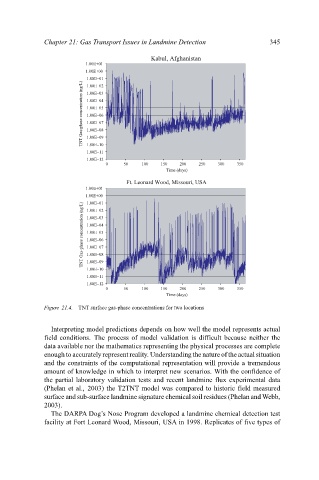
                           Figure 21.4. TNT surface gas-phase concentrations for two locations


                             Interpreting model predictions depends on how well the model represents actual
                           field conditions. The process of model validation is difficult because neither the
                           data available nor the mathematics representing the physical processes are complete
                           enough to accurately represent reality. Understanding the nature of the actual situation
                           and the constraints of the computational representation will provide a tremendous
                           amount of knowledge in which to interpret new scenarios. With the confidence of
                           the partial laboratory validation tests and recent landmine flux experimental data
                           (Phelan et al., 2003) the T2TNT model was compared to historic field measured
                           surface and sub-surface landmine signature chemical soil residues (Phelan and Webb,
                           2003).
                             The DARPA Dog’s Nose Program developed a landmine chemical detection test
                           facility at Fort Leonard Wood, Missouri, USA in 1998. Replicates of five types of

