


Page 352 - gas transport in porous media
P. 352
Falta
                           354
                             Removal of the trapped NAPL generally requires mass transfer of the NAPL com-
                           ponents into either the gas phase or the aqueous phase, where they can be pumped
                           out, or destroyed by aqueous or gas phase chemical or biological reactions. Arguably,
                           the most successful NAPL/VOC remediation schemes have used the gas phase to
                           transfer contaminants out of the subsurface, or to deliver beneficial chemicals or
                           nutrients to the subsurface. Generally speaking, remediation methods that rely on
                           gas phase extraction are most effective for chemicals that have high vapor pressures
                           and Henry’s constants, while methods that rely on gas phase delivery of chemicals or
                           nutrients can attack a wider range of contaminants.
                             Obviously, remediation schemes based on gas phase transport are applicable in
                           the vadose zone, above the water table, however there are also effective remediation
                           methods that involve injecting air or steam below the water table. The following
                           sections describe some of the more popular gas-based remediation methods forVOCs.


                           22.2  SOIL VAPOR EXTRACTION
                           22.2.1  Introduction to SVE Applications, Induced Gas Flow

                           Soil vapor extraction is probably the simplest, most common, and most successful of
                           all of the in-situ techniques for removing VOC’s from the vadose zone. SVE systems
                           use one or more wells screened above the water table. A blower connected to the well
                           normally provides the vacuum (typically from 0.05 to 0.2 atmospheres) that induces
                                                                                            3
                           flow to the well. Typical gas flow rates are in the range of 50 to 300 cfm (0.024 m /s
                                   3
                           to 0.14 m /s) depending on the vacuum in the well and the gas phase permeability.
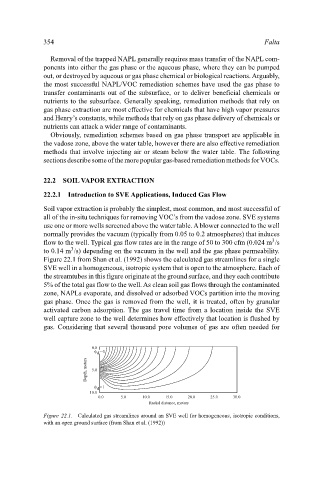
                           Figure 22.1 from Shan et al. (1992) shows the calculated gas streamlines for a single
                           SVE well in a homogeneous, isotropic system that is open to the atmosphere. Each of
                           the streamtubes in this figure originate at the ground surface, and they each contribute
                           5% of the total gas flow to the well. As clean soil gas flows through the contaminated
                           zone, NAPLs evaporate, and dissolved or adsorbed VOCs partition into the moving
                           gas phase. Once the gas is removed from the well, it is treated, often by granular
                           activated carbon adsorption. The gas travel time from a location inside the SVE
                           well capture zone to the well determines how effectively that location is flushed by
                           gas. Considering that several thousand pore volumes of gas are often needed for


                                         0.0
                                         c d =0
                                       Depth, meters  5.0


                                         c d =1
                                        10.0
                                          0.0    5.0   10.0  15.0   20.0  25.0   30.0
                                                         Radial distance, meters
                           Figure 22.1.  Calculated gas streamlines around an SVE well for homogeneous, isotropic conditions,
                           with an open ground surface (from Shan et al. (1992))

