


Page 353 - gas transport in porous media
P. 353
Chapter 22: Environmental Remediation of Volatile Organic Compounds
                                            0.9 1                                          355
                                                   isotropic
                                            0.8    anisotropic
                                            0.7

                                            0.6
                                           c d  0.5

                                            0.4

                                            0.3

                                            0.2
                                            0.1

                                              0
                                              10 3  10 4   10 5  10 6  10 7  10 8
                                                          Time, seconds
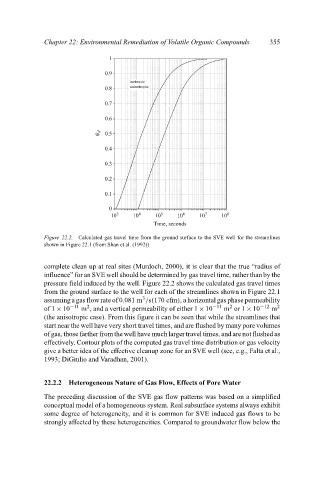
                           Figure 22.2.  Calculated gas travel time from the ground surface to the SVE well for the streamlines
                           shown in Figure 22.1 (from Shan et al. (1992))


                           complete clean up at real sites (Murdoch, 2000), it is clear that the true “radius of
                           influence” for an SVE well should be determined by gas travel time, rather than by the
                           pressure field induced by the well. Figure 22.2 shows the calculated gas travel times
                           from the ground surface to the well for each of the streamlines shown in Figure 22.1
                                                       3
                           assuming a gas flow rate of 0.081 m /s(170 cfm), a horizontal gas phase permeability
                                                                                2
                                       2
                           of 1 × 10 −11  m , and a vertical permeability of either 1 × 10 −11  m or 1 × 10 −12  m 2
                           (the anisotropic case). From this figure it can be seen that while the streamlines that
                           start near the well have very short travel times, and are flushed by many pore volumes
                           of gas, those farther from the well have much larger travel times, and are not flushed as
                           effectively. Contour plots of the computed gas travel time distribution or gas velocity
                           give a better idea of the effective cleanup zone for an SVE well (see, e.g., Falta et al.,
                           1993; DiGiulio and Varadhan, 2001).


                           22.2.2  Heterogeneous Nature of Gas Flow, Effects of Pore Water
                           The preceding discussion of the SVE gas flow patterns was based on a simplified
                           conceptual model of a homogeneous system. Real subsurface systems always exhibit
                           some degree of heterogeneity, and it is common for SVE induced gas flows to be
                           strongly affected by these heterogeneities. Compared to groundwater flow below the

