


Page 358 - gas transport in porous media
P. 358
360
                                                  Gas flow through local channels
                                                   in water-filled porous media           Falta
                                                                Air
                                              1mm    Air
                                                                        Water
                                                                        filled


                                            Water
                                            filled

                                                      Air       Air

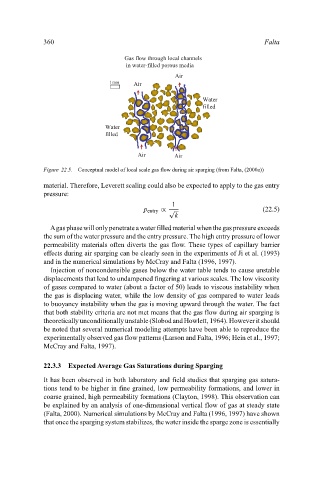
                           Figure 22.5.  Conceptual model of local scale gas flow during air sparging (from Falta, (2000a))

                           material. Therefore, Leverett scaling could also be expected to apply to the gas entry
                           pressure:
                                                               1
                                                       p entry ∝ √                       (22.5)
                                                                k
                             Agas phase will only penetrate a water filled material when the gas pressure exceeds
                           the sum of the water pressure and the entry pressure. The high entry pressure of lower
                           permeability materials often diverts the gas flow. These types of capillary barrier
                           effects during air sparging can be clearly seen in the experiments of Ji et al. (1993)
                           and in the numerical simulations by McCray and Falta (1996, 1997).
                             Injection of noncondensible gases below the water table tends to cause unstable
                           displacements that lead to undampened fingering at various scales. The low viscosity
                           of gases compared to water (about a factor of 50) leads to viscous instability when
                           the gas is displacing water, while the low density of gas compared to water leads
                           to buoyancy instability when the gas is moving upward through the water. The fact
                           that both stability criteria are not met means that the gas flow during air sparging is
                           theoretically unconditionally unstable (Slobod and Howlett, 1964). However it should
                           be noted that several numerical modeling attempts have been able to reproduce the
                           experimentally observed gas flow patterns (Larson and Falta, 1996; Hein et al., 1997;
                           McCray and Falta, 1997).


                           22.3.3  Expected Average Gas Saturations during Sparging
                           It has been observed in both laboratory and field studies that sparging gas satura-
                           tions tend to be higher in fine grained, low permeability formations, and lower in
                           coarse grained, high permeability formations (Clayton, 1998). This observation can
                           be explained by an analysis of one-dimensional vertical flow of gas at steady state
                           (Falta, 2000). Numerical simulations by McCray and Falta (1996, 1997) have shown
                           that once the sparging system stabilizes, the water inside the sparge zone is essentially

