


Page 362 - gas transport in porous media
P. 362
Falta
                           364
                           methods (see, e.g., Falta et al., 1992; Adenekan, 1992; Falta, 2000b; Ochs et al.,
                           2002). In some cases, analytical solutions can also provide useful estimates of the
                           condensation front characteristics (Menegus and Udell, 1985; Hunt et al., 1988;
                           Stewart and Udell, 1988).
                           22.4.2  Condensation Front Velocity, Steam Velocity, and
                           NAPL Evaporation Velocity
                           There are at least three different velocities that are of interest in steam flooding.
                           The condensation or steam front velocity is the speed at which the steam zone
                           grows. The steam velocity is the Darcy velocity of the steam behind the conden-
                           sation front. Because the steam condenses back to liquid water at the condensation
                           front with a volume change of about a factor of 1600, the steam velocity is much
                           larger than the steam front velocity. The NAPL evaporation velocity is the speed
                           at which an evaporation front moves through immobile NAPL trapped at residual
                           saturation.
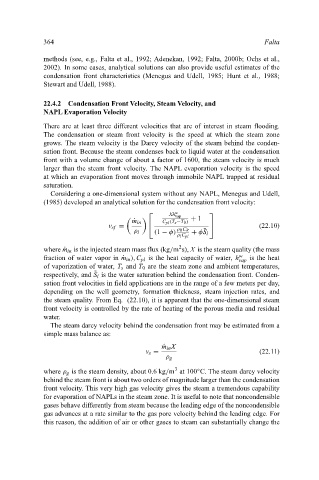
                             Considering a one-dimensional system without any NAPL, Menegus and Udell,
                           (1985) developed an analytical solution for the condensation front velocity:
                                                               Xh
                                                         ⎡      w         ⎤
                                                       	        vap  + 1
                                                    ˙ m in   C pl (T s −T 0 )
                                             v sf =      ⎣                ⎦             (22.10)
                                                                        ¯
                                                     ρ l  (1 − φ)  ρ R C R  + φS l
                                                                 ρ l C pl
                                                                 2
                           where ˙m in is the injected steam mass flux (kg/m s), X is the steam quality (the mass
                           fraction of water vapor in ˙m in ), C pl is the heat capacity of water, h w  is the heat
                                                                                  vap
                           of vaporization of water, T s and T 0 are the steam zone and ambient temperatures,
                                         ¯
                           respectively, and S l is the water saturation behind the condensation front. Conden-
                           sation front velocities in field applications are in the range of a few meters per day,
                           depending on the well geometry, formation thickness, steam injection rates, and
                           the steam quality. From Eq. (22.10), it is apparent that the one-dimensional steam
                           front velocity is controlled by the rate of heating of the porous media and residual
                           water.
                             The steam darcy velocity behind the condensation front may be estimated from a
                           simple mass balance as:
                                                             ˙ m in X
                                                        v s =                           (22.11)
                                                              ρ g
                                                                3
                                                                       ◦
                           where ρ g is the steam density, about 0.6 kg/m at 100 C. The steam darcy velocity
                           behind the steam front is about two orders of magnitude larger than the condensation
                           front velocity. This very high gas velocity gives the steam a tremendous capability
                           for evaporation of NAPLs in the steam zone. It is useful to note that noncondensible
                           gases behave differently from steam because the leading edge of the noncondensible
                           gas advances at a rate similar to the gas pore velocity behind the leading edge. For
                           this reason, the addition of air or other gases to steam can substantially change the

