


Page 364 - gas transport in porous media
P. 364
Falta
                           366
                           where M l is the mass of liquid water. The volumetric rate at which vapor is created and
                           leaves the system is equal to the rate at which the liquid mass is depleted by boiling,
                           divided by the gas (steam) density. The rate at which vapor phase chemical leaves
                           the system is then equal to the product of the gas concentration, and the volumetric
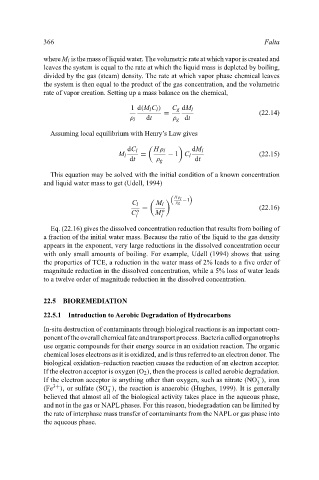
                           rate of vapor creation. Setting up a mass balance on the chemical,
                                                    1 d(M l C l )  C g dM l
                                                             =                          (22.14)
                                                   ρ l  dt      ρ g dt
                             Assuming local equilibrium with Henry’s Law gives


                                                   dC l   Hρ l       dM l
                                                M l    =      − 1 C l                   (22.15)
                                                   dt      ρ g        dt
                             This equation may be solved with the initial condition of a known concentration
                           and liquid water mass to get (Udell, 1994)


                                                              	 Hρ l
                                                                  −1
                                                    C l    M l  ρ g
                                                       =     o                          (22.16)
                                                     o
                                                    C      M
                                                     l      l
                             Eq. (22.16) gives the dissolved concentration reduction that results from boiling of
                           a fraction of the initial water mass. Because the ratio of the liquid to the gas density
                           appears in the exponent, very large reductions in the dissolved concentration occur
                           with only small amounts of boiling. For example, Udell (1994) shows that using
                           the properties of TCE, a reduction in the water mass of 2% leads to a five order of
                           magnitude reduction in the dissolved concentration, while a 5% loss of water leads
                           to a twelve order of magnitude reduction in the dissolved concentration.


                           22.5  BIOREMEDIATION

                           22.5.1  Introduction to Aerobic Degradation of Hydrocarbons
                           In-situ destruction of contaminants through biological reactions is an important com-
                           ponent of the overall chemical fate and transport process. Bacteria called organotrophs
                           use organic compounds for their energy source in an oxidation reaction. The organic
                           chemical loses electrons as it is oxidized, and is thus referred to an electron donor. The
                           biological oxidation–reduction reaction causes the reduction of an electron acceptor.
                           If the electron acceptor is oxygen (O 2 ), then the process is called aerobic degradation.
                                                                                        −
                           If the electron acceptor is anything other than oxygen, such as nitrate (NO ), iron
                                                                                        3
                                             −
                           (Fe 3+ ), or sulfate (SO ), the reaction is anaerobic (Hughes, 1999). It is generally
                                             4
                           believed that almost all of the biological activity takes place in the aqueous phase,
                           and not in the gas or NAPL phases. For this reason, biodegradation can be limited by
                           the rate of interphase mass transfer of contaminants from the NAPL or gas phase into
                           the aqueous phase.

