


Page 365 - gas transport in porous media
P. 365
367
                           Chapter 22: Environmental Remediation of Volatile Organic Compounds
                             Many of the hydrocarbon compounds are readily biodegradable in water under
                           aerobic conditions. The most highly regulated components of hydrocarbon fuels,
                           benzene, toluene, ethylbenzene, and xylenes, (BTEX) are degraded quickly under
                           aerobic conditions (Alvarez and Vogel, 1991). While the details of the aerobic reac-
                           tions, and their kinetics are fairly complex, the oxygen demand can be estimated
                           from straightforward stoichiometric relationships. For example, an estimate of the
                           amount of oxygen needed to aerobically degrade hydrocarbons is calculated using a
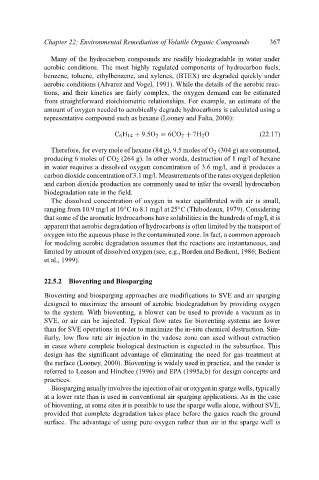
                           representative compound such as hexane (Looney and Falta, 2000):

                                               C 6 H 14 + 9.5O 2 = 6CO 2 + 7H 2 O       (22.17)

                             Therefore, for every mole of hexane (84 g), 9.5 moles of O 2 (304 g) are consumed,
                           producing 6 moles of CO 2 (264 g). In other words, destruction of 1 mg/l of hexane
                           in water requires a dissolved oxygen concentration of 3.6 mg/l, and it produces a
                           carbon dioxide concentration of 3.1 mg/l. Measurements of the rates oxygen depletion
                           and carbon dioxide production are commonly used to infer the overall hydrocarbon
                           biodegradation rate in the field.
                             The dissolved concentration of oxygen in water equilibrated with air is small,
                                                                 ◦
                                                  ◦
                           ranging from 10.9 mg/l at 10 C to 8.1 mg/l at 25 C (Thibodeaux, 1979). Considering
                           that some of the aromatic hydrocarbons have solubilities in the hundreds of mg/l, it is
                           apparent that aerobic degradation of hydrocarbons is often limited by the transport of
                           oxygen into the aqueous phase in the contaminated zone. In fact, a common approach
                           for modeling aerobic degradation assumes that the reactions are instantaneous, and
                           limited by amount of dissolved oxygen (see, e.g., Borden and Bedient, 1986; Bedient
                           et al., 1999).


                           22.5.2  Bioventing and Biosparging
                           Bioventing and biosparging approaches are modifications to SVE and air sparging
                           designed to maximize the amount of aerobic biodegradation by providing oxygen
                           to the system. With bioventing, a blower can be used to provide a vacuum as in
                           SVE, or air can be injected. Typical flow rates for bioventing systems are lower
                           than for SVE operations in order to maximize the in-situ chemical destruction. Sim-
                           ilarly, low flow rate air injection in the vadose zone can used without extraction
                           in cases where complete biological destruction is expected in the subsurface. This
                           design has the significant advantage of eliminating the need for gas treatment at
                           the surface (Looney, 2000). Bioventing is widely used in practice, and the reader is
                           referred to Leeson and Hinchee (1996) and EPA (1995a,b) for design concepts and
                           practices.
                             Biosparging usuallyinvolves the injection of air oroxygen in sparge wells, typically
                           at a lower rate than is used in conventional air sparging applications. As in the case
                           of bioventing, at some sites it is possible to use the sparge wells alone, without SVE,
                           provided that complete degradation takes place before the gases reach the ground
                           surface. The advantage of using pure oxygen rather than air in the sparge well is

