


Page 159 - Geochemical Remote Sensing of The Sub-Surface
P. 159
136                                     V. T. Jones,  M.D.  Matthews and D.M.  Richers

                  O(Oa )   5 DcH4[ppt]           (b)   8 13Ccthane[ppt ]
                 -3    -250  -200   -150   -lO0      -50   -40   -30   -20
               -70                             -70 t   I    I     I    I
                                                  /
               -60                             -60


               -50
                                             d
             r..)                            m
            cO -40                             -40


              -30                              3~                         I
                                                 l         ~(h~ ~         I
              -20
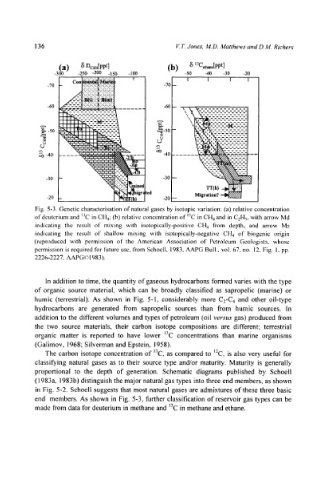
           Fig. 5-3. Genetic characterisation  of natural gases by isotopic variation: (a) relative concentration
           of deuterium and  ~3C in C|t4; (b) relative concentration  of '3C in CH4 and in C2H5, with arrow Md
           indicating  the  result  of  mixing  with  isotopically-positive  CH4  from depth,  and  arrow  Ms
           indicating  the  result  of  shallow  mixing  with  isotopically-negative  CH4  ol"  biogenic  origin
           (reproduced  with  permission  of  the  American  Association  of  Petroleum  Geologists,  whose
           permission  is required for future use, from Schoell,  1983, AAPG Bull., vol. 67, no.  12, Fig. 1, pp.
           2226-2227,  AAPG~) 1983).


              In addition  to time, the quantity of gaseous hydrocarbons  formed  varies  with the type
           of  organic  source  material,  which  can  be  broadly  classified  as  sapropelic  (marine)  or
           humic  (terrestrial).  As  shown  in  Fig.  5-1,  considerably  more  C2-C4  and  other  oil-type
           hydrocarbons  are  generated  from  sapropelic  sources  than  from  humic  sources.  In
           addition  to the  different  volumes  and  types  of petroleum  (oil  versus  gas)  produced  from
           the  two  source  materials,  their  carbon  isotope  compositions  are  different;  terrestrial
           organic  matter  is  reported  to  have  lower  ~3C  concentrations  than  marine  organisms
           (Galimov,  1968;  Silverman  and  Epstein,  1958).
              The  carbon  isotope  concentration  of  ~3C, as  compared  to  t2C, is  also  very  useful  for
           classifying  natural  gases  as  to  their  source  type  and/or  maturity.  Maturity  is  generally
           proportional  to  the  depth  of  generation.  Schematic  diagrams  published  by  Schoell
           (1983a,  1983b) distinguish the major natural  gas types  into three  end members,  as shown
           in  Fig.  5-2.  Schoell  suggests  that  most  natural  gases  are  admixtures  of these  three  basic
           end  members.  As  shown  in  Fig.  5-3,  further  classification  of reservoir  gas  types  can  be
           made  from data for deuterium  in methane  and  ~3C in methane  and ethane.

