


Page 160 - Geochemical Remote Sensing of The Sub-Surface
P. 160
Light hydrocarbons for petroleum and gas prospecting                  137


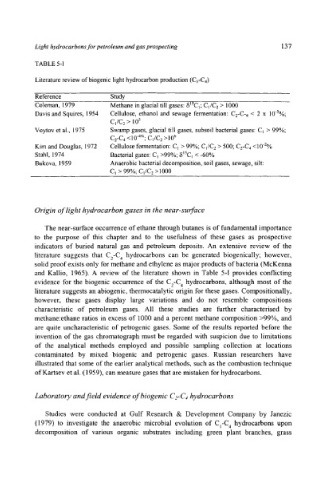
           TABLE 5-I

           Literature review ofbiogenic light hydrocarbon production (C1-C4)
           Reference            Study
           Coleman,  1979       Methane in glacial till gases: ~i3c1; CI/C 2 > 1000
           Davis and Squires, 1954   Cellulose,  ethanol and  sewage  fermentation:  C2-C-4 <  2  x  I0-5%;
                                Cl/C2 > 105
           Voytov et al.,  1975   Swamp gases, glacial till gases, subsoil bacterial gases: C1 > 99%;
                                C2-C4 < 10-4'~'; C1/C2 > 106
           Kim and Douglas,  1972   Cellulose fermentation: C~ > 99%; C~/C2 > 500; C2-C4 <10-2%
           Stahl, 1974          Bacterial gases: C~ >99%; 813CI <-60%
           Bukova, 1959         Anaerobic bacterial decomposition, soil gases, sewage, silt:
                                C~ > 99%; Ci/C2 >1000


           Origin of light hydrocarbon gases in the near-surface


              The near-surface occurrence  of ethane  through butanes  is of fundamental  importance
           to  the  purpose  of  this  chapter  and  to  the  usefulness  of  these  gases  as  prospective
           indicators  of  buried  natural  gas  and  petroleum  deposits.  An  extensive  review  of  the
           literature  suggests  that  C2-C 4  hydrocarbons  can  be  generated  biogenically;  however,
           solid proof exists only for methane and ethylene as major products  of bacteria (McKenna
           and  Kallio,  1965).  A  review  of  the  literature  shown  in  Table  5-I  provides  conflicting
           evidence  for  the  biogenic  occurrence  of the  C2-C 4 hydrocarbons,  although  most  of the
           literature suggests an abiogenic,  thermocatalytic origin for these  gases.  Compositionally,
           however,  these  gases  display  large  variations  and  do  not  resemble  compositions
           characteristic  of  petroleum  gases.  All  these  studies  are  further  characterised  by
           methane:ethane  ratios  in excess  of  1000  and  a percent  methane  composition  >99%,  and
           are  quite  uncharacteristic  of petrogenic  gases.  Some  of  the  results  reported  before  the
           invention  of the  gas  chromatograph  must be  regarded  with  suspicion  due  to  limitations
           of  the  analytical  methods  employed  and  possible  sampling  collection  at  locations
           contaminated  by  mixed  biogenic  and  petrogenic  gases.  Russian  researchers  have
           illustrated that some of the  earlier analytical methods,  such as the  combustion  technique
           of Kartsev et al. (1959),  can measure gases that are mistaken for hydrocarbons.


           Laboratory and field evidence of biogenic C2-C4 hydrocarbons

              Studies  were  conducted  at  Gulf  Research  &  Development  Company  by  Janezic
           (1979)  to  investigate  the  anaerobic  microbial  evolution  of  C~-C 4 hydrocarbons  upon
           decomposition  of  various  organic  substrates  including  green  plant  branches,  grass

