


Page 161 - Geochemical Remote Sensing of The Sub-Surface
P. 161
138                                     V.T. Jones,  M.D.  Matthews and D.M.  Richers

            1 - Liter Modified SOHNGEN Flask     Nutrient Medlunl
           Substrate Added                       NH4CI    1.0 g

                                                K.z*O 4   1.og
                            Nutrient Added
                      e/
            Autoclave                         MgSO 4 -7H20  0.5g
                                                 CaCI 2   0.5 g
                            Innoculate
                                                 Water    1000 ml
           Incubate                             Deionlzed, Distilled,
                                                & Degassed
                            Chromatographic
                            Analysis
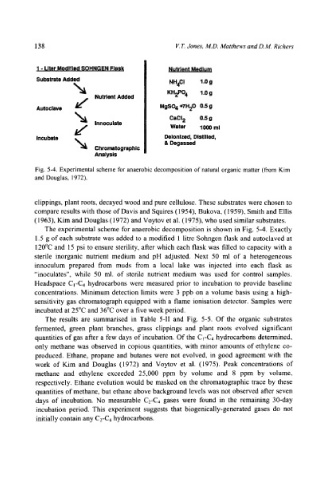
           Fig. 5-4. Experimental scheme for anaerobic decomposition of natural organic matter (from Kim
           and Douglas, 1972).


           clippings, plant roots, decayed wood and pure cellulose.  These  substrates were chosen to
           compare results with those of Davis and Squires (1954), Bukova, (1959),  Smith and Ellis
           (1963), Kim and Douglas (1972) and Voytov et al. (1975), who used similar substrates.
              The  experimental  scheme  for anaerobic  decomposition  is shown  in Fig.  5-4.  Exactly
           1.5  g of each  substrate  was  added  to a modified  1 litre  Sohngen  flask and  autoclaved  at
           120~  and  15 psi  to ensure  sterility,  after which  each  flask was  filled  to  capacity  with  a
           sterile  inorganic  nutrient  medium  and  pH  adjusted.  Next  50  ml  of  a  heterogeneous
           innoculum  prepared  from  muds  from  a  local  lake  was  injected  into  each  flask  as
           "inoculates",  while  50  ml.  of  sterile  nutrient  medium  was  used  for  control  samples.
           Headspace  C~-C4 hydrocarbons  were  measured  prior  to  incubation  to  provide  baseline
           concentrations.  Minimum  detection  limits  were  3  ppb  on  a  volume  basis  using  a  high-
           sensitivity  gas  chromatograph  equipped  with  a  flame  ionisation  detector.  Samples  were
           incubated at 25~  and 36~  over a five week period.
              The  results  are  summarised  in  Table  5-II  and  Fig.  5-5.  Of  the  organic  substrates
           fermented,  green  plant  branches,  grass  clippings  and  plant  roots  evolved  significant
           quantities  of gas after a few days of incubation.  Of the  C~-C4 hydrocarbons determined,
           only methane  was  observed  in  copious  quantities,  with  minor  amounts  of ethylene  co-
           produced.  Ethane,  propane  and  butanes  were  not  evolved,  in  good  agreement  with  the
           work  of  Kim  and  Douglas  (1972)  and  Voytov  et  al.  (1975).  Peak  concentrations  of
           methane  and  ethylene  exceeded  25,000  ppm  by  volume  and  8  ppm  by  volume,
           respectively.  Ethane  evolution  would  be  masked  on the  chromatographic  trace  by these
           quantities  of methane,  but ethane above background levels was not observed after seven
           days  of  incubation.  No  measurable  C2-C4 gases  were  found  in  the  remaining  30-day
           incubation  period.  This  experiment  suggests  that  biogenically-generated  gases  do  not
           initially contain any C2-Ca hydrocarbons.

