


Page 303 -
P. 303
274
                274   P P a r t   V :  a r t   V :    T T h e   G r e e n i n g   P r o c e s sh e   G r e e n i n g   P r o c e s s


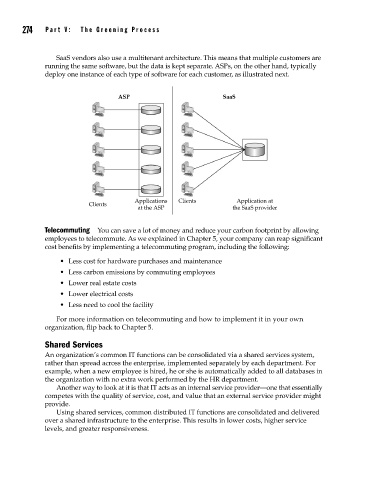
                         SaaS vendors also use a multitenant architecture. This means that multiple customers are
                      running the same software, but the data is kept separate. ASPs, on the other hand, typically
                      deploy one instance of each type of software for each customer, as illustrated next.


                                          ASP                           SaaS


                                               Applications  Clients       Application at
                                  Clients
                                                at the ASP                the SaaS provider

                      Telecommuting  You can save a lot of money and reduce your carbon footprint by allowing
                      employees to telecommute. As we explained in Chapter 5, your company can reap significant
                      cost benefits by implementing a telecommuting program, including the following:

                          •  Less cost for hardware purchases and maintenance
                          •  Less carbon emissions by commuting employees
                          •  Lower real estate costs
                          •  Lower electrical costs
                          •  Less need to cool the facility

                         For more information on telecommuting and how to implement it in your own
                      organization, flip back to Chapter 5.

                      Shared Services
                      An organization’s common IT functions can be consolidated via a shared services system,
                      rather than spread across the enterprise, implemented separately by each department. For
                      example, when a new employee is hired, he or she is automatically added to all databases in
                      the organization with no extra work performed by the HR department.
                         Another way to look at it is that IT acts as an internal service provider—one that essentially
                      competes with the quality of service, cost, and value that an external service provider might
                      provide.
                         Using shared services, common distributed IT functions are consolidated and delivered
                      over a shared infrastructure to the enterprise. This results in lower costs, higher service
                      levels, and greater responsiveness.

