


Page 314 -
P. 314
285
                                                                       C C h a p t e r   1 4 :  h a p t e r   1 4 :    S S t a y i n g   G r e e n  t a y i n g   G r e e n    285


                      Qualitative Reviews
                      Qualitative reviews are fuzzier than quantitative reviews. Whereas quantitative reviews
                      focus on cold, hard numbers, qualitative reviews try to put numbers in a context to explain
                      them. Such data can include the following:
                          •  Interviews  Talk to colleagues and employees to seek informed opinions, anecdotal
                             information, lessons learned, and in-house audits.
                          •  Review policies  Look at your organizational policies and procedures to figure out
                             what impact they are having on your energy use.

                      Conduct Audits
                      Baselining and assessing your performance are great to do, but these tasks are only part of
                      the story. You should also periodically assess and audit the performance of equipment,
                      processes, and systems to help identify opportunities for improvement.
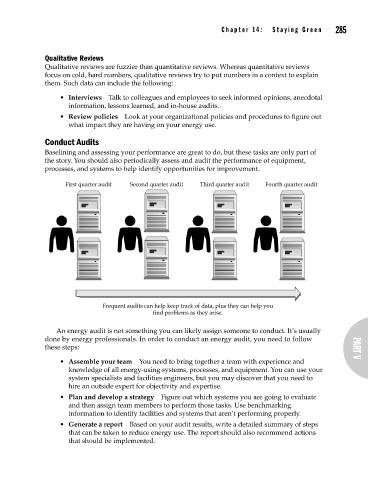
                            First quarter audit  Second quarter audit  Third quarter audit  Fourth quarter audit


                                      Frequent audits can help keep track of data, plus they can help you
                                                    find problems as they arise.

                         An energy audit is not something you can likely assign someone to conduct. It’s usually
                      done by energy professionals. In order to conduct an energy audit, you need to follow
                      these steps:                                                                          PART V
                          •  Assemble your team  You need to bring together a team with experience and
                             knowledge of all energy-using systems, processes, and equipment. You can use your
                             system specialists and facilities engineers, but you may discover that you need to
                             hire an outside expert for objectivity and expertise.
                          •  Plan and develop a strategy  Figure out which systems you are going to evaluate
                             and then assign team members to perform those tasks. Use benchmarking
                             information to identify facilities and systems that aren’t performing properly.
                          •  Generate a report  Based on your audit results, write a detailed summary of steps
                             that can be taken to reduce energy use. The report should also recommend actions
                             that should be implemented.

