


Page 251 - Handbook Of Multiphase Flow Assurance
P. 251
250                          10.  Research methods in flow assurance

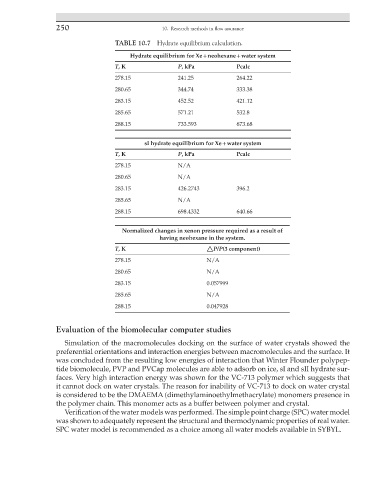
                                 TABLE 10.7  Hydrate equilibrium calculation.
                                     Hydrate equilibrium for Xe + neohexane + water system
                                 T, K             P, kPa           Pcalc
                                 278.15           241.25           264.22
                                 280.65           344.74           333.38
                                 283.15           452.52           421.12
                                 285.65           571.21           532.8
                                 288.15           733.593          673.68

                                         sI hydrate equilibrium for Xe + water system
                                 T, K             P, kPa           Pcalc
                                 278.15           N/A
                                 280.65           N/A
                                 283.15           426.2743         396.2
                                 285.65           N/A
                                 288.15           698.4332         640.66

                                   Normalized changes in xenon pressure required as a result of
                                             having neohexane in the system.
                                 T, K                     △P/P(3 component)
                                 278.15                   N/A
                                 280.65                   N/A
                                 283.15                   0.057999
                                 285.65                   N/A
                                 288.15                   0.047928


                 Evaluation of the biomolecular computer studies

                   Simulation of the macromolecules docking on the surface of water crystals showed the
                 preferential orientations and interaction energies between macromolecules and the surface. It
                 was concluded from the resulting low energies of interaction that Winter Flounder polypep-
                 tide biomolecule, PVP and PVCap molecules are able to adsorb on ice, sI and sII hydrate sur-
                 faces. Very high interaction energy was shown for the VC-713 polymer which suggests that
                 it cannot dock on water crystals. The reason for inability of VC-713 to dock on water crystal
                 is considered to be the DMAEMA (dimethylaminoethylmethacrylate) monomers presence in
                 the polymer chain. This monomer acts as a buffer between polymer and crystal.
                   Verification of the water models was performed. The simple point charge (SPC) water model
                 was shown to adequately represent the structural and thermodynamic properties of real water.
                 SPC water model is recommended as a choice among all water models available in SYBYL.

