


Page 287 - Handbook Of Multiphase Flow Assurance
P. 287
286                          10.  Research methods in flow assurance

                 Hydrate crystal growth
                   It is difficult to study the growth of the natural gas hydrate crystals, both because pressures
                 above atmospheric are required and because the hydrocarbon “guest” molecules are spar-
                 ingly soluble in water, so that crystallization occurs mainly at the gas-liquid interface (Long,
                 1994). It is more convenient to use tetrahydrofuran (THF) as a hydrate former because it is
                 completely miscible in water. Clathrate hydrates of THF melt at 4.38 °C at atmospheric pres-
                 sure (Erva, 1956). The THF hydrate is known to have a cubic structure (face-centered cubic,
                 diamondoid) (Palmer, 1950) and is classified as a structure II hydrate (Mak and McMullan,
                 1965). There are no published data about the shape of single THF hydrate crystals. A study of
                 shape of the negative crystals of THF hydrates (McLaurin and Whalley, 1988) showed that the
                 voids melted in a THF hydrate had an octahedral shape.
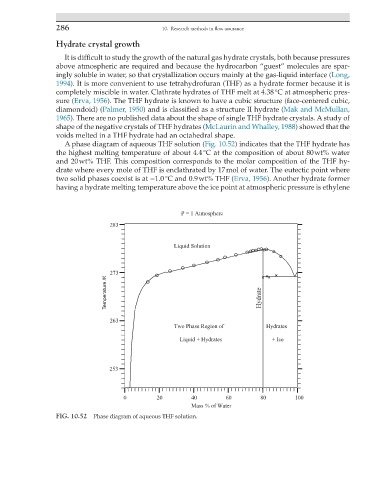
                   A phase diagram of aqueous THF solution (Fig. 10.52) indicates that the THF hydrate has
                 the highest melting temperature of about 4.4 °C at the composition of about 80 wt% water
                 and 20 wt% THF. This composition corresponds to the molar composition of the THF hy-
                 drate where every mole of THF is enclathrated by 17 mol of water. The eutectic point where
                 two solid phases coexist is at −1.0 °C and 0.9 wt% THF (Erva, 1956). Another hydrate former
                   having a hydrate melting temperature above the ice point at atmospheric pressure is ethylene


                 FIG. 10.52  Phase diagram of aqueous THF solution.

