


Page 277 - Handbook of Energy Engineering Calculations
P. 277
percent, while the absolute head drops 53.8 percent (from 3.9 to 1.8 m). This
               is why the tail-water level is so important in small hydro installations.
                  Figure 3c shows how station costs can rise as head decreases. These costs
               were estimated by the department of energy (DOE) for a number of small
               hydro-power installations. Figure 3d shows that station cost is more sensitive

               to  head  than  to  power  capacity,  according  to  DOE  estimates.  And  the
               prohibitive costs for developing a completely new small hydro site mean that
               nearly all work will be at existing dams. Hence, any water exploitation for

               power must not encroach seriously on present customs, rights, and usages of
               the water. This holds for both upstream and downstream conditions.


               3. Outline machinery choice considerations
               Small-turbine manufacturers, heeding the new needs, are producing a good
               range  of  semistandard  designs  that  will  match  any  site  needs  in  regard  to

               head, capacity, and excavation restrictions.
                  The  Francis  turbine,  Fig.  2,  is  a  good  example  of  such  designs.  A
               horizontal-shaft  Francis  turbine  may  be  a  better  choice  for  some  small
               projects  because  of  lower  civil-engineering  costs  and  compatibility  with

               standard generators.
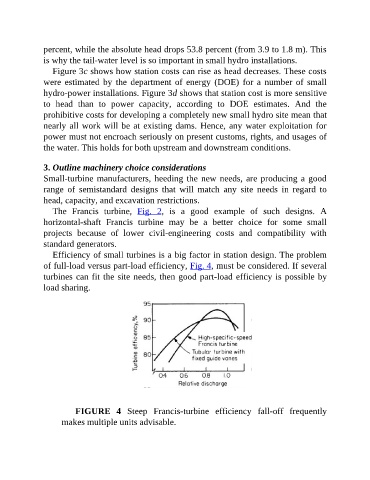
                  Efficiency of small turbines is a big factor in station design. The problem
               of full-load versus part-load efficiency, Fig. 4, must be considered. If several
               turbines can fit the site needs, then good part-load efficiency is possible by

               load sharing.


                          FIGURE  4  Steep  Francis-turbine  efficiency  fall-off  frequently
                     makes multiple units advisable.

