


Page 281 - Handbook of Instrumental Techniques for Analytical Chemistry
P. 281
Infrared Spectroscopy                                                                      271


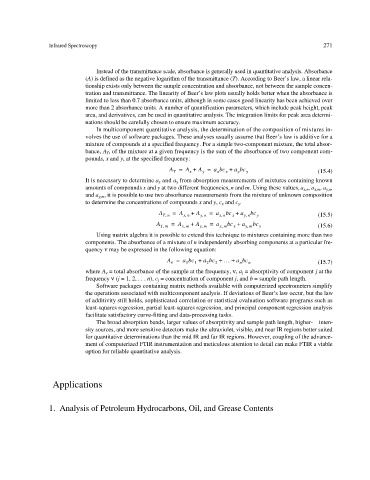
                                 Instead of the transmittance scale, absorbance is generally used in quantitative analysis. Absorbance
                             (A) is defined as the negative logarithm of the transmittance (T). According to Beer’s law, a linear rela-
                             tionship exists only between the sample concentration and absorbance, not between the sample concen-
                             tration and transmittance. The linearity of Beer’s law plots usually holds better when the absorbance is
                             limited to less than 0.7 absorbance units, although in some cases good linearity has been achieved over
                             more than 2 absorbance units. A number of quantification parameters, which include peak height, peak
                             area, and derivatives, can be used in quantitative analysis. The integration limits for peak area determi-
                             nations should be carefully chosen to ensure maximum accuracy.
                                 In multicomponent quantitative analysis, the determination of the composition of mixtures in-
                             volves the use of software packages. These analyses usually assume that Beer’s law is additive for a
                             mixture of compounds at a specified frequency. For a simple two-component mixture, the total absor-
                             bance, A T , of the mixture at a given frequency is the sum of the absorbance of two component com-
                             pounds, x and y, at the specified frequency:
                                                         A =  A +  A =  a bc +  a bc
                                                          T     x   y    x  x  y  y                       (15.4)
                             It is necessary to determine a x  and a y  from absorption measurements of mixtures containing known
                             amounts of compounds x and y at two different frequencies, n and m. Using these values, a x,n , a x,m , a y,n ,
                             and a y,m , it is possible to use two absorbance measurements from the mixture of unknown composition
                             to determine the concentrations of compounds x and y, c x  and c y .
                                                     A    =  A  +  A  =  a  bc +  a  bc
                                                                          ,
                                                                    ,
                                                        ,
                                                                                  ,
                                                              ,
                                                       T n    x n  y n   x n  x   y n  y                  (15.5)
                                                     A    =  A  +  A  =  a  bc +  a  bc
                                                                                   ,
                                                       ,
                                                              ,
                                                                          ,
                                                                    ,
                                                      T m    x m   y m    x m  x  y m  y                  (15.6)
                                 Using matrix algebra it is possible to extend this technique to mixtures containing more than two
                             components. The absorbance of a mixture of n independently absorbing components at a particular fre-
                             quency n may be expressed in the following equation:
                                                        A =  a bc +  a bc +  … +  a bc
                                                         n    1  1   2  2       n  n                      (15.7)
                             where A n  = total absorbance of the sample at the frequency, n, a j  = absorptivity of component j at the
                             frequency n (j = 1, 2, . . . n), c j  = concentration of component j, and b = sample path length.
                                 Software packages containing matrix methods available with computerized spectrometers simplify
                             the operations associated with multicomponent analysis. If deviations of Beer’s law occur, but the law
                             of additivity still holds, sophisticated correlation or statistical evaluation software programs such as
                             least-squares regression, partial least-squares regression, and principal component regression analysis
                             facilitate satisfactory curve-fitting and data-processing tasks.
                                 The broad absorption bands, larger values of absorptivity and sample path length, higher-    inten-
                             sity sources, and more sensitive detectors make the ultraviolet, visible, and near IR regions better suited
                             for quantitative determinations than the mid IR and far IR regions. However, coupling of the advance-
                             ment of computerized FTIR instrumentation and meticulous attention to detail can make FTIR a viable
                             option for reliable quantitative analysis.


                  Applications


                 1. Analysis of Petroleum Hydrocarbons, Oil, and Grease Contents

