


Page 283 - Handbook of Instrumental Techniques for Analytical Chemistry
P. 283
Infrared Spectroscopy                                                                      273


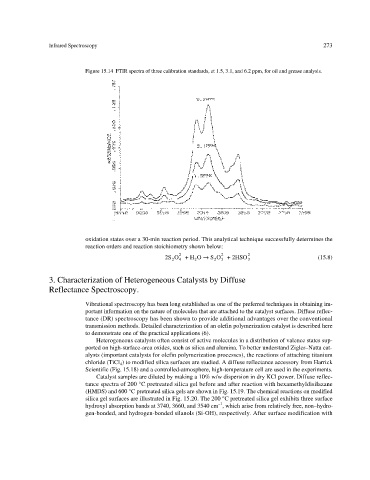
                             Figure 15.14 FTIR spectra of three calibration standards, at 1.5, 3.1, and 6.2 ppm, for oil and grease analysis.


                             oxidation states over a 30-min reaction period. This analytical technique successfully determines the
                             reaction orders and reaction stoichiometry shown below:
                                                            2–            2–       2–
                                                       2S O   +  H O fi  S O  +  2HSO                      (15.8)
                                                          2  4   2      2  3       3

                 3. Characterization of Heterogeneous Catalysts by Diffuse
                 Reflectance Spectroscopy.

                             Vibrational spectroscopy has been long established as one of the preferred techniques in obtaining im-
                             portant information on the nature of molecules that are attached to the catalyst surfaces. Diffuse reflec-
                             tance (DR) spectroscopy has been shown to provide additional advantages over the conventional
                             transmission methods. Detailed characterization of an olefin polymerization catalyst is described here
                             to demonstrate one of the practical applications (6).
                                 Heterogeneous catalysts often consist of active molecules in a distribution of valence states sup-
                             ported on high-surface-area oxides, such as silica and alumina. To better understand Zigler–Natta cat-
                             alysts (important catalysts for olefin polymerization processes), the reactions of attaching titanium
                             chloride (TiCl 4 ) to modified silica surfaces are studied. A diffuse reflectance accessory from Harrick
                             Scientific (Fig. 15.18) and a controlled-atmosphere, high-temperature cell are used in the experiments.
                                 Catalyst samples are diluted by making a 10% w/w dispersion in dry KCl power. Diffuse reflec-
                             tance spectra of 200 °C pretreated silica gel before and after reaction with hexamethyldisilazane
                             (HMDS) and 600 °C pretreated silica gels are shown in Fig. 15.19. The chemical reactions on modified
                             silica gel surfaces are illustrated in Fig. 15.20. The 200 °C pretreated silica gel exhibits three surface
                                                                         –1
                             hydroxyl absorption bands at 3740, 3660, and 3540 cm , which arise from relatively free, non–hydro-
                             gen-bonded, and hydrogen-bonded silanols (Si-OH), respectively. After surface modification with

