


Page 372 - Handbook of Materials Failure Analysis
P. 372
370    CHAPTER 14 Fatigue failure analysis of welded structures


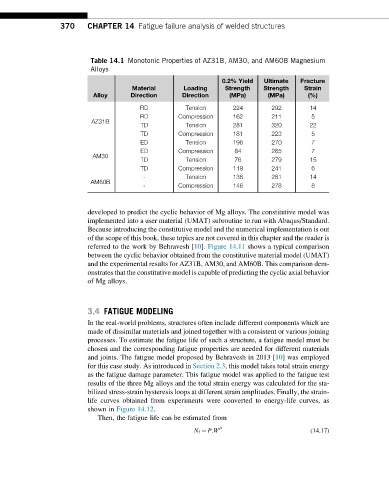
                          Table 14.1 Monotonic Properties of AZ31B, AM30, and AM60B Magnesium
                          Alloys
                                                               0.2% Yield  Ultimate  Fracture
                                      Material      Loading    Strength   Strength   Strain
                           Alloy     Direction      Direction    (MPa)     (MPa)      (%)

                                        RD          Tension       224       292        14
                                        RD        Compression     162       211        5
                          AZ31B
                                        TD          Tension       281       320        22
                                        TD        Compression     181       223        5
                                        ED          Tension       196       270        7
                                        ED        Compression     84        265        7
                           AM30
                                        TD          Tension       76        279        15
                                        TD        Compression     119       241        6
                                         -          Tension       138       281        14
                          AM60B
                                         -        Compression     146       278        8

                         developed to predict the cyclic behavior of Mg alloys. The constitutive model was
                         implemented into a user material (UMAT) subroutine to run with Abaqus/Standard.
                         Because introducing the constitutive model and the numerical implementation is out
                         of the scope of this book, these topics are not covered in this chapter and the reader is
                         referred to the work by Behravesh [10]. Figure 14.11 shows a typical comparison
                         between the cyclic behavior obtained from the constitutive material model (UMAT)
                         and the experimental results for AZ31B, AM30, and AM60B. This comparison dem-
                         onstrates that the constitutive model is capable of predicting the cyclic axial behavior
                         of Mg alloys.


                         3.4 FATIGUE MODELING
                         In the real-world problems, structures often include different components which are
                         made of dissimilar materials and joined together with a consistent or various joining
                         processes. To estimate the fatigue life of such a structure, a fatigue model must be
                         chosen and the corresponding fatigue properties are needed for different materials
                         and joints. The fatigue model proposed by Behravesh in 2013 [10] was employed
                         for this case study. As introduced in Section 2.3, this model takes total strain energy
                         as the fatigue damage parameter. This fatigue model was applied to the fatigue test
                         results of the three Mg alloys and the total strain energy was calculated for the sta-
                         bilized stress-strain hysteresis loops at different strain amplitudes. Finally, the strain-
                         life curves obtained from experiments were converted to energy-life curves, as
                         shown in Figure 14.12.
                            Then, the fatigue life can be estimated from
                                                       N f ¼ P:W t q                   (14.17)

