


Page 369 - Handbook of Materials Failure Analysis
P. 369
3 Case Study: Fatigue Life Assessment of an Automotive Demo-Structure  367


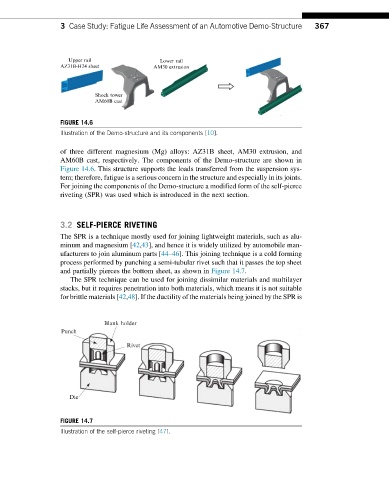
                    Upper rail               Lower rail
                  AZ31B-H24 sheet           AM30 extrusion


                           Shock tower
                           AM60B cast


                  FIGURE 14.6
                  Illustration of the Demo-structure and its components [10].

                  of three different magnesium (Mg) alloys: AZ31B sheet, AM30 extrusion, and
                  AM60B cast, respectively. The components of the Demo-structure are shown in
                  Figure 14.6. This structure supports the loads transferred from the suspension sys-
                  tem; therefore, fatigue is a serious concern in the structure and especially in its joints.
                  For joining the components of the Demo-structure a modified form of the self-pierce
                  riveting (SPR) was used which is introduced in the next section.


                  3.2 SELF-PIERCE RIVETING
                  The SPR is a technique mostly used for joining lightweight materials, such as alu-
                  minum and magnesium [42,43], and hence it is widely utilized by automobile man-
                  ufacturers to join aluminum parts [44–46]. This joining technique is a cold forming
                  process performed by punching a semi-tubular rivet such that it passes the top sheet
                  and partially pierces the bottom sheet, as shown in Figure 14.7.
                     The SPR technique can be used for joining dissimilar materials and multilayer
                  stacks, but it requires penetration into both materials, which means it is not suitable
                  for brittle materials [42,48]. If the ductility of the materials being joined by the SPR is


                              Blank holder
                  Punch
                                    Rivet


                    Die


                  FIGURE 14.7
                  Illustration of the self-pierce riveting [47].

