


Page 390 - Handbook of Materials Failure Analysis
P. 390
388    CHAPTER 15 Welding-associated failures in power boilers


                         1 MATERIAL APPLICATIONS IN POWER BOILERS –
                         INTRODUCTION

                         The function of a boiler is to produce superheated steam by transferring the heat pro-
                         duced by the combustion of oil or natural gas to water and steam flowing through the
                         tubes that form the boiler. The super-heaters consist of banks of tubes suspended in
                         the combustion gas flow path in the upper parts of the boiler. The steam flows
                         from the super-heaters through the main steam header to the main turbine, where
                         it drives the turbine-generator. The service conditions involved in boilers, which
                         are mainly governed by alternating high temperatures and induced thermal stresses;
                         residual stresses in welds; as well as the harsh corrosive environments, promotes fail-
                         ure causes such as thermal fatigue; stress-corrosion cracking (SCC); corrosion; and
                         premature creep failures due to stress raisers at welding defects.
                            In high-temperature service (345-815 °C), and in the design of pressure vessels and
                         piping, engineers and designers are confronted with the problem of selecting materials
                         for a wide range of service conditions. The chromium molybdenum ferritic and austen-
                         iticstainlesssteels(SSs)aregenerallyusedfordesigntemperaturesabove425 °C[1].In
                         addition to service temperature, corrosion resistance, and fabricability, the following
                         conditions should beconsidered in high-temperature applications: allowable maximum
                         temperature and stress, type and value of load, expected life of the structure, and cost.
                            Austenitic SSs are generally used for design temperatures above 425 °C, the
                         ASME code, section VIII, division 1, shows the SS grades that are suitable for
                         the normal temperature range of usage (345-815 °C). Also some creep-resistant mar-
                         tensitic and ferritic SSs are used for high-temperature applications. The duplex stain-
                         less steels (DSSs) with both ferrite and austenite phases have gained increasing
                         interest in recent years in power generation applications in chloride-containing solu-
                         tions due to their better resistance to localized corrosion compared to single-phase
                         austenitic SSs [2–4]. Welded DSSs are used at temperatures up to 250 °C. The
                         increase in the thermal efficiency of fossil fuel-fired steam power plants, that can
                         be achieved by increasing the steam temperature and pressure, has provided the
                         incentive for the development of heat-resistant steels with excellent creep properties,
                         as well as superior oxidation and corrosion resistance properties [5]. In the last two
                         decades and to face up these requirements; several new Cr-Mo and 9-12% chromium
                         steels were developed ranging from P11 (1Cr-0.5Mo) to P122 (12Cr-1Mo) [6].
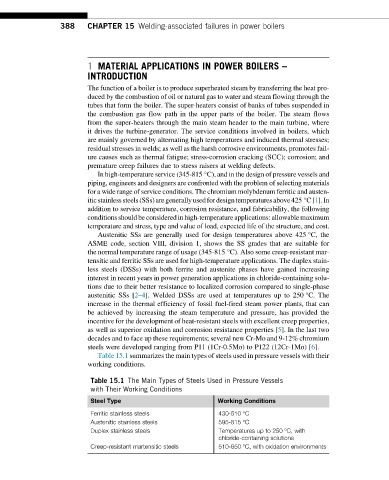
                            Table 15.1 summarizes the main types of steels used in pressure vessels with their
                         working conditions.
                          Table 15.1 The Main Types of Steels Used in Pressure Vessels
                          with Their Working Conditions
                          Steel Type                         Working Conditions
                          Ferritic stainless steels           430-510 °C
                          Austenitic stainless steels         595-815 °C
                          Duplex stainless steels             Temperatures up to 250 °C, with
                                                              chloride-containing solutions
                          Creep-resistant martensitic steels  510-650 °C, with oxidation environments

