


Page 394 - Handbook of Materials Failure Analysis
P. 394
392    CHAPTER 15 Welding-associated failures in power boilers


                         welded joints. The conditions that favor the formation of austenite, such as high nitro-
                         gen content and low cooling rate, minimize the formation of Cr 2 N precipitates, and
                         increase the volume fraction of austenite. During cooling after welding of DSS the
                         δ-ferrite transforms to austenite; the greater the cooling rate after welding the lower will
                         be the austenite content, which deteriorates the tensile and corrosion properties of weld
                         metal and HAZ. In order to increase austenite content in the weld metal, Ni-enriched
                         filler metals (9% Ni) are used. The structure in the HAZ would accordingly exhibit
                         increased δ-ferrite/austenite ratio compared to the base metal due to either fast cooling
                         rates from the solution annealing temperature 1050 °C or to decomposition of the aus-
                         tenite to ferrite during holding at the temperature ffi600 °C[15]. Moreover, DSS are
                         prone to age hardening and embrittlement at virtually all temperatures above 300 °C.
                         At higher temperatures above 475 °C rapid aging results from the precipitation of var-
                         ious intermetallic phases (σ, χ, R,and G phases) [16].


                         2.4 WELDING PROBLEMS
                         The common welding problems encountered in SSs are sensitization, SCC, hot
                         cracking, HAZ cracking, weld metal solidification cracking, and fissuring. These
                         problems are discussed briefly in the following sections.

                         2.4.1 Sensitization
                         This problem can cause a rapid attack at the welding position. When the steel is
                         heated at the temperature range of 500-850 °C, the carbon combines with chromium
                         and forms carbides. These carbide particles form preferentially at grain boundaries,
                         causing the depletion of chromium at the surrounding area. This results in a local loss
                         of corrosion resistance. This process is called sensitization. This kind of damage
                         takes place during welding at the HAZ, where the peak temperature reaches 600-
                         850 °C, and therefore a localized damage called weld decay occurs in the HAZ,
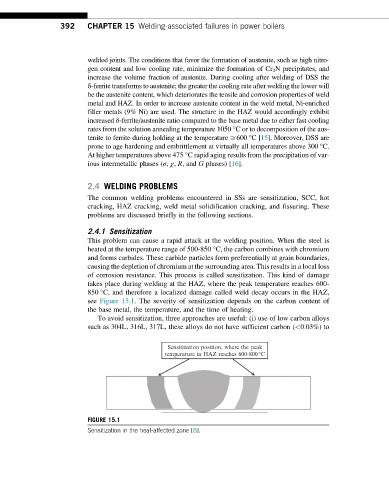
                         see Figure 15.1. The severity of sensitization depends on the carbon content of
                         the base metal, the temperature, and the time of heating.
                            To avoid sensitization, three approaches are useful: (i) use of low carbon alloys
                         such as 304L, 316L, 317L, these alloys do not have sufficient carbon (<0.03%) to


                                               Sensitization position, where the peak
                                               temperature in HAZ reaches 600-800 °C


                         FIGURE 15.1
                         Sensitization in the heat-affected zone [8].

