


Page 398 - Handbook of Materials Failure Analysis
P. 398
396    CHAPTER 15 Welding-associated failures in power boilers


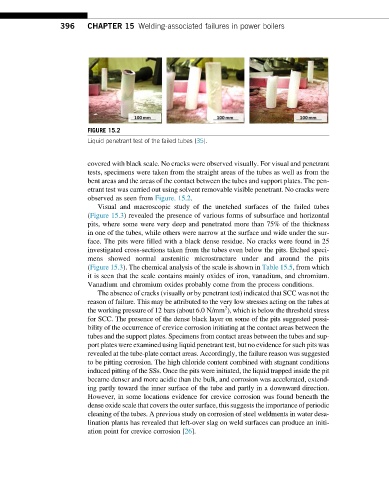
                         FIGURE 15.2
                         Liquid penetrant test of the failed tubes [35].


                         covered with black scale. No cracks were observed visually. For visual and penetrant
                         tests, specimens were taken from the straight areas of the tubes as well as from the
                         bent areas and the areas of the contact between the tubes and support plates. The pen-
                         etrant test was carried out using solvent removable visible penetrant. No cracks were
                         observed as seen from Figure. 15.2.
                            Visual and macroscopic study of the unetched surfaces of the failed tubes
                         (Figure 15.3) revealed the presence of various forms of subsurface and horizontal
                         pits, where some were very deep and penetrated more than 75% of the thickness
                         in one of the tubes, while others were narrow at the surface and wide under the sur-
                         face. The pits were filled with a black dense residue. No cracks were found in 25
                         investigated cross-sections taken from the tubes even below the pits. Etched speci-
                         mens showed normal austenitic microstructure under and around the pits
                         (Figure 15.3). The chemical analysis of the scale is shown in Table 15.5, from which
                         it is seen that the scale contains mainly oxides of iron, vanadium, and chromium.
                         Vanadium and chromium oxides probably come from the process conditions.
                            The absence of cracks (visually or by penetrant test) indicated that SCC was not the
                         reason of failure. This may be attributed to the very low stresses acting on the tubes at
                                                               2
                         the working pressure of 12 bars (about 6.0 N/mm ), which is below the threshold stress
                         for SCC. The presence of the dense black layer on some of the pits suggested possi-
                         bility of the occurrence of crevice corrosion initiating at the contact areas between the
                         tubes and the support plates. Specimens from contact areas between the tubes and sup-
                         port plates were examined using liquid penetrant test, but no evidence for such pits was
                         revealed at the tube-plate contact areas. Accordingly, the failure reason was suggested
                         to be pitting corrosion. The high chloride content combined with stagnant conditions
                         induced pitting of the SSs. Once the pits were initiated, the liquid trapped inside the pit
                         became denser and more acidic than the bulk, and corrosion was accelerated, extend-
                         ing partly toward the inner surface of the tube and partly in a downward direction.
                         However, in some locations evidence for crevice corrosion was found beneath the
                         dense oxide scale that covers the outer surface, this suggests the importance of periodic
                         cleaning of the tubes. A previous study on corrosion of steel weldments in water desa-
                         lination plants has revealed that left-over slag on weld surfaces can produce an initi-
                         ation point for crevice corrosion [26].

