


Page 400 - Handbook of Materials Failure Analysis
P. 400
398    CHAPTER 15 Welding-associated failures in power boilers


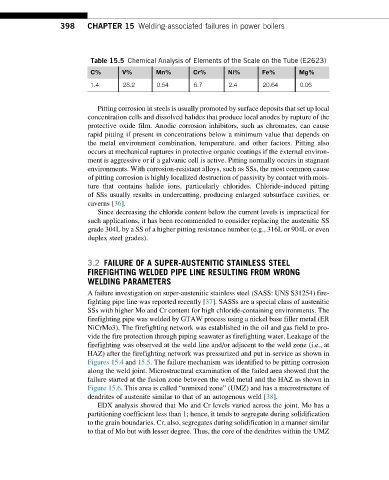
                          Table 15.5 Chemical Analysis of Elements of the Scale on the Tube (E2623)
                          C%       V%       Mn%        Cr%      Ni%       Fe%       Mg%
                          1.4      28.2     0.54       6.7      2.4       20.64     0.06


                            Pitting corrosion in steels is usually promoted by surface deposits that set up local
                         concentration cells and dissolved halides that produce local anodes by rupture of the
                         protective oxide film. Anodic corrosion inhibitors, such as chromates, can cause
                         rapid pitting if present in concentrations below a minimum value that depends on
                         the metal environment combination, temperature, and other factors. Pitting also
                         occurs at mechanical ruptures in protective organic coatings if the external environ-
                         ment is aggressive or if a galvanic cell is active. Pitting normally occurs in stagnant
                         environments. With corrosion-resistant alloys, such as SSs, the most common cause
                         of pitting corrosion is highly localized destruction of passivity by contact with mois-
                         ture that contains halide ions, particularly chlorides. Chloride-induced pitting
                         of SSs usually results in undercutting, producing enlarged subsurface cavities, or
                         caverns [36].
                            Since decreasing the chloride content below the current levels is impractical for
                         such applications, it has been recommended to consider replacing the austenitic SS
                         grade 304L by a SS of a higher pitting resistance number (e.g., 316L or 904L or even
                         duplex steel grades).


                         3.2 FAILURE OF A SUPER-AUSTENITIC STAINLESS STEEL
                         FIREFIGHTING WELDED PIPE LINE RESULTING FROM WRONG
                         WELDING PARAMETERS
                         A failure investigation on super-austenitic stainless steel (SASS: UNS S31254) fire-
                         fighting pipe line was reported recently [37]. SASSs are a special class of austenitic
                         SSs with higher Mo and Cr content for high chloride-containing environments. The
                         firefighting pipe was welded by GTAW process using a nickel base filler metal (ER
                         NiCrMo3). The firefighting network was established in the oil and gas field to pro-
                         vide the fire protection through piping seawater as firefighting water. Leakage of the
                         firefighting was observed at the weld line and/or adjacent to the weld zone (i.e., at
                         HAZ) after the firefighting network was pressurized and put in-service as shown in
                         Figures 15.4 and 15.5. The failure mechanism was identified to be pitting corrosion
                         along the weld joint. Microstructural examination of the failed area showed that the
                         failure started at the fusion zone between the weld metal and the HAZ as shown in
                         Figure 15.6. This area is called “unmixed zone” (UMZ) and has a microstructure of
                         dendrites of austenite similar to that of an autogenous weld [38].
                            EDX analysis showed that Mo and Cr levels varied across the joint. Mo has a
                         partitioning coefficient less than 1; hence, it tends to segregate during solidification
                         to the grain boundaries. Cr, also, segregates during solidification in a manner similar
                         to that of Mo but with lesser degree. Thus, the core of the dendrites within the UMZ

