


Page 397 - Handbook of Materials Failure Analysis
P. 397
3 Stress-Corrosion Induced Failures  395


                  thickness at faster rates than general corrosion. Pitting corrosion is usually initiated
                  by a number of factors depending on the working environment. The pits usually ini-
                  tiate at surface defects (scratches, local changes in composition, or damage to pro-
                  tective coating). Pitting corrosion may also be caused by bacteria in promoting
                  environments such as the oil industry. Microbiologically influenced corrosion
                  caused by sulfate-reducing bacteria has been found to be a serious threat to pipelines.
                  The presence of oxygen (even at low levels 0.1-0.2 ppm in pipeline water) promotes
                  bacterial corrosion. The presence of CO 2 also causes severe corrosion, which is
                  sometimes called “mesa” corrosion [34].
                     A failure study on two reboiler 304L tubes from two trains at Obaiyed Field was
                  conducted at the Faculty of Engineering Cairo University [35]. The steam reboilers
                  consist of a large number of tubes bent in U shape supported by tube sheets, all being
                  contained in a large shell. The tubes carry hot oil at about 260 °C under pressure of
                  12 bar and the outer diameter of the tubes (shell side) is in contact with water. The
                  temperature and the pressure of the water were 150 °C and 5 bar, respectively. The
                  water analysis obtained from BAPETCO reports showed that the chloride content
                  was in the range of 10-70 ppm for train E2613 and from 8 to 62 ppm in train
                  E2623. This range of chloride content is relatively high for austenitic SS 304, espe-
                  cially at high working temperature of this equipment. The data indicated that the
                  chloride content in the steam generators feed water was around 15 5 ppm and
                  around 60 5 ppm at the outlet. The data also showed that the pH ranged from
                  5.8 to 10.4.
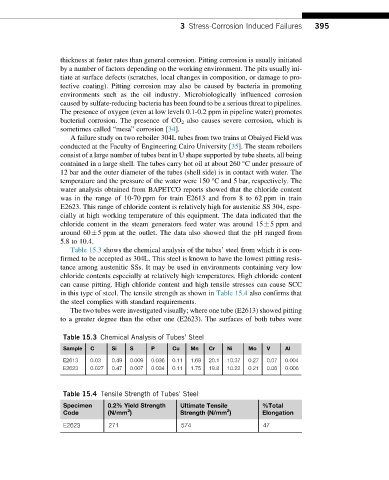
                     Table 15.3 shows the chemical analysis of the tubes’ steel from which it is con-
                  firmed to be accepted as 304L. This steel is known to have the lowest pitting resis-
                  tance among austenitic SSs. It may be used in environments containing very low
                  chloride contents especially at relatively high temperatures. High chloride content
                  can cause pitting. High chloride content and high tensile stresses can cause SCC
                  in this type of steel. The tensile strength as shown in Table 15.4 also confirms that
                  the steel complies with standard requirements.
                     The two tubes were investigated visually; where one tube (E2613) showed pitting
                  to a greater degree than the other one (E2623). The surfaces of both tubes were

                   Table 15.3 Chemical Analysis of Tubes’ Steel
                   Sample  C    Si   S     P     Cu   Mn   Cr   Ni    Mo   V    Al
                   E2613  0.03  0.49  0.009  0.036  0.11  1.69  20.1  10.37  0.27  0.07  0.004
                   E2623  0.027  0.47  0.007  0.034  0.11  1.75  19.8  10.22  0.21  0.06  0.006


                   Table 15.4 Tensile Strength of Tubes’ Steel
                   Specimen    0.2% Yield Strength  Ultimate Tensile      %Total
                                                                2
                                    2
                   Code        (N/mm )             Strength (N/mm )       Elongation
                   E2623       271                 574                    47

