


Page 402 - Handbook of Materials Failure Analysis
P. 402
400    CHAPTER 15 Welding-associated failures in power boilers


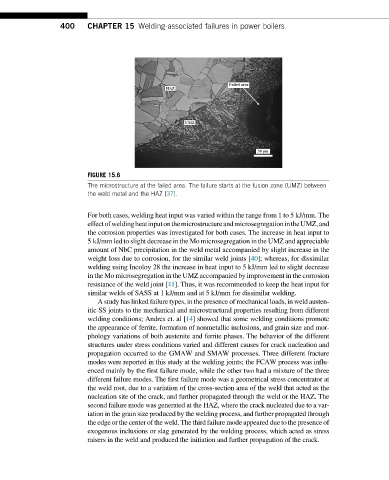
                         FIGURE 15.6
                         The microstructure at the failed area. The failure starts at the fusion zone (UMZ) between
                         the weld metal and the HAZ [37].


                         For both cases, welding heat input was varied within the range from 1 to 5 kJ/mm. The
                         effectofweldingheatinputonthemicrostructureandmicrosegregationintheUMZ,and
                         the corrosion properties was investigated for both cases. The increase in heat input to
                         5 kJ/mm led to slight decrease in the Mo microsegregation in the UMZ and appreciable
                         amount of NbC precipitation in the weld metal accompanied by slight increase in the
                         weight loss due to corrosion, for the similar weld joints [40]; whereas, for dissimilar
                         welding using Incoloy 28 the increase in heat input to 5 kJ/mm led to slight decrease
                         in the Mo microsegregation in the UMZ accompanied by improvement in the corrosion
                         resistance of the weld joint [41]. Thus, it was recommended to keep the heat input for
                         similar welds of SASS at 1 kJ/mm and at 5 kJ/mm for dissimilar welding.
                            A study has linked failure types, in the presence of mechanical loads, in weld austen-
                         itic SS joints to the mechanical and microstructural properties resulting from different
                         welding conditions; Andres et. al [14] showed that some welding conditions promote
                         the appearance of ferrite, formation of nonmetallic inclusions, and grain size and mor-
                         phology variations of both austenite and ferrite phases. The behavior of the different
                         structures under stress conditions varied and different causes for crack nucleation and
                         propagation occurred to the GMAW and SMAW processes. Three different fracture
                         modes were reported in this study at the welding joints; the FCAW process was influ-
                         enced mainly by the first failure mode, while the other two had a mixture of the three
                         different failure modes. The first failure mode was a geometrical stress concentrator at
                         the weld root, due to a variation of the cross-section area of the weld that acted as the
                         nucleation site of the crack, and further propagated through the weld or the HAZ. The
                         second failure mode was generated at the HAZ, where the crack nucleated due to a var-
                         iation in the grain size produced by the welding process, and further propagated through
                         the edge or the center of the weld. The third failure mode appeared due to the presence of
                         exogenous inclusions or slag generated by the welding process, which acted as stress
                         raisers in the weld and produced the initiation and further propagation of the crack.

