


Page 405 - Handbook of Materials Failure Analysis
P. 405
3 Stress-Corrosion Induced Failures  403


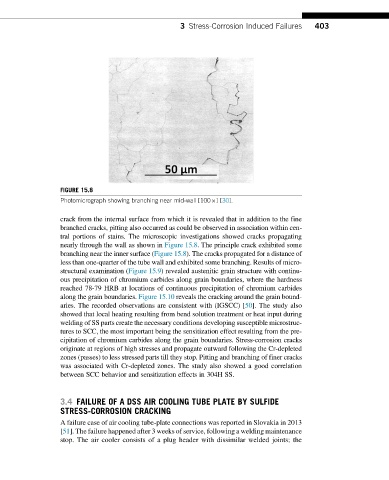
                  FIGURE 15.8
                  Photomicrograph showing branching near mid-wall [100 ][30].


                  crack from the internal surface from which it is revealed that in addition to the fine
                  branched cracks, pitting also occurred as could be observed in association within cen-
                  tral portions of stains. The microscopic investigations showed cracks propagating
                  nearly through the wall as shown in Figure 15.8. The principle crack exhibited some
                  branching near the inner surface (Figure 15.8). The cracks propagated for a distance of
                  less than one-quarter of the tube wall and exhibited some branching. Results of micro-
                  structural examination (Figure 15.9) revealed austenitic grain structure with continu-
                  ous precipitation of chromium carbides along grain boundaries, where the hardness
                  reached 78-79 HRB at locations of continuous precipitation of chromium carbides
                  along the grain boundaries. Figure 15.10 reveals the cracking around the grain bound-
                  aries. The recorded observations are consistent with (IGSCC) [50]. The study also
                  showed that local heating resulting from bend solution treatment or heat input during
                  welding of SS parts create the necessary conditions developing susceptible microstruc-
                  tures to SCC, the most important being the sensitization effect resulting from the pre-
                  cipitation of chromium carbides along the grain boundaries. Stress-corrosion cracks
                  originate at regions of high stresses and propagate outward following the Cr-depleted
                  zones (passes) to less stressed parts till they stop. Pitting and branching of finer cracks
                  was associated with Cr-depleted zones. The study also showed a good correlation
                  between SCC behavior and sensitization effects in 304H SS.


                  3.4 FAILURE OF A DSS AIR COOLING TUBE PLATE BY SULFIDE
                  STRESS-CORROSION CRACKING
                  A failure case of air cooling tube-plate connections was reported in Slovakia in 2013
                  [51]. The failure happened after 3 weeks of service, following a welding maintenance
                  stop. The air cooler consists of a plug header with dissimilar welded joints; the

