


Page 406 - Handbook of Materials Failure Analysis
P. 406
404    CHAPTER 15 Welding-associated failures in power boilers


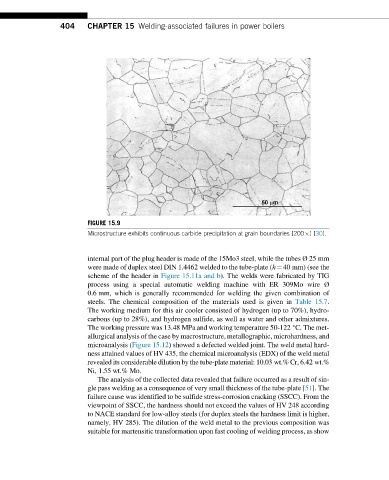
                         FIGURE 15.9
                         Microstructure exhibits continuous carbide precipitation at grain boundaries [200 ][30].


                         internal part of the plug header is made of the 15Mo3 steel, while the tubes Ø 25 mm
                         were made of duplex steel DIN 1.4462 welded to the tube-plate (h¼40 mm) (see the
                         scheme of the header in Figure 15.11a and b). The welds were fabricated by TIG
                         process using a special automatic welding machine with ER 309Mo wire Ø
                         0.6 mm, which is generally recommended for welding the given combination of
                         steels. The chemical composition of the materials used is given in Table 15.7.
                         The working medium for this air cooler consisted of hydrogen (up to 70%), hydro-
                         carbons (up to 28%), and hydrogen sulfide, as well as water and other admixtures.
                         The working pressure was 13.48 MPa and working temperature 50-122 °C. The met-
                         allurgical analysis of the case by macrostructure, metallographic, microhardness, and
                         microanalysis (Figure 15.12) showed a defected welded joint. The weld metal hard-
                         ness attained values of HV 435, the chemical microanalysis (EDX) of the weld metal
                         revealed its considerable dilution by the tube-plate material: 10.03 wt.% Cr, 6.42 wt.%
                         Ni, 1.55 wt.% Mo.
                            The analysis of the collected data revealed that failure occurred as a result of sin-
                         gle pass welding as a consequence of very small thickness of the tube-plate [51]. The
                         failure cause was identified to be sulfide stress-corrosion cracking (SSCC). From the
                         viewpoint of SSCC, the hardness should not exceed the values of HV 248 according
                         to NACE standard for low-alloy steels (for duplex steels the hardness limit is higher,
                         namely, HV 285). The dilution of the weld metal to the previous composition was
                         suitable for martensitic transformation upon fast cooling of welding process, as show

