


Page 434 - Handbook of Materials Failure Analysis
P. 434
432    CHAPTER 16 Degradation of protective PVD coatings


                         delamination. The coating delaminated under cyclic dynamic loading easily
                         undergoes shear fracture through the entire coating thickness that ends with coating
                         removal. Another effect of coating undulation is an initiation and increase of tensile
                         stresses in a coating at the bottom and top of undulation—“hills.” These stresses lead
                         to crack initiation and its progress. However, delamination contributes to the stress
                         release at the bottom of hills and undulations. Delaminated coating fractures easily
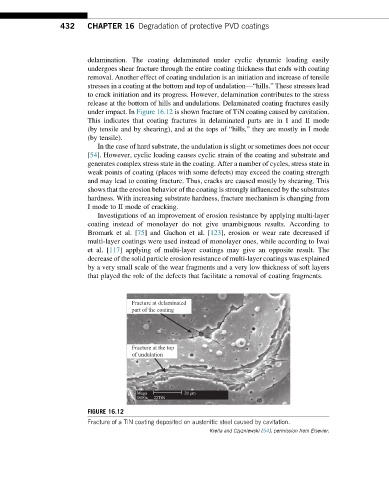
                         under impact. In Figure 16.12 is shown fracture of TiN coating caused by cavitation.
                         This indicates that coating fractures in delaminated parts are in I and II mode
                         (by tensile and by shearing), and at the tops of “hills,” they are mostly in I mode
                         (by tensile).
                            In the case of hard substrate, the undulation is slight or sometimes does not occur
                         [54]. However, cyclic loading causes cyclic strain of the coating and substrate and
                         generates complex stress state in the coating. After a number of cycles, stress state in
                         weak points of coating (places with some defects) may exceed the coating strength
                         and may lead to coating fracture. Thus, cracks are caused mostly by shearing. This
                         shows that the erosion behavior of the coating is strongly influenced by the substrates
                         hardness. With increasing substrate hardness, fracture mechanism is changing from
                         I mode to II mode of cracking.
                            Investigations of an improvement of erosion resistance by applying multi-layer
                         coating instead of monolayer do not give unambiguous results. According to
                         Bromark et al. [75] and Gachon et al. [123], erosion or wear rate decreased if
                         multi-layer coatings were used instead of monolayer ones, while according to Iwai
                         et al. [117] applying of multi-layer coatings may give an opposite result. The
                         decrease of the solid particle erosion resistance of multi-layer coatings was explained
                         by a very small scale of the wear fragments and a very low thickness of soft layers
                         that played the role of the defects that facilitate a removal of coating fragments.


                                      Fracture at delaminated
                                      part of the coating


                                      Fracture at the top
                                      of undulation


                                       Magn         20 μm
                                       1000x  22TiN
                         FIGURE 16.12
                         Fracture of a TiN coating deposited on austenitic steel caused by cavitation.
                                                           Krella and Czyzniewski [54], permission from Elsevier.

