


Page 435 - Handbook of Materials Failure Analysis
P. 435
8 Conclusion    433


                        (a)                         (b)


                                                     Shear
                        TiN
                                                     fracture
                         Ti


                                                                  Tensile
                                                                  fracture
                                              1 μm                          1 μm

                  FIGURE 16.13
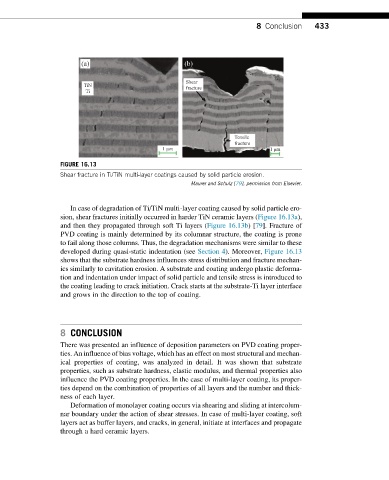
                  Shear fracture in Ti/TiN multi-layer coatings caused by solid particle erosion.
                                                      Maurer and Schulz [79], permission from Elsevier.


                     In case of degradation of Ti/TiN multi-layer coating caused by solid particle ero-
                  sion, shear fractures initially occurred in harder TiN ceramic layers (Figure 16.13a),
                  and then they propagated through soft Ti layers (Figure 16.13b)[79]. Fracture of
                  PVD coating is mainly determined by its columnar structure, the coating is prone
                  to fail along those columns. Thus, the degradation mechanisms were similar to these
                  developed during quasi-static indentation (see Section 4). Moreover, Figure 16.13
                  shows that the substrate hardness influences stress distribution and fracture mechan-
                  ics similarly to cavitation erosion. A substrate and coating undergo plastic deforma-
                  tion and indentation under impact of solid particle and tensile stress is introduced to
                  the coating leading to crack initiation. Crack starts at the substrate-Ti layer interface
                  and grows in the direction to the top of coating.


                  8 CONCLUSION
                  There was presented an influence of deposition parameters on PVD coating proper-
                  ties. An influence of bias voltage, which has an effect on most structural and mechan-
                  ical properties of coating, was analyzed in detail. It was shown that substrate
                  properties, such as substrate hardness, elastic modulus, and thermal properties also
                  influence the PVD coating properties. In the case of multi-layer coating, its proper-
                  ties depend on the combination of properties of all layers and the number and thick-
                  ness of each layer.
                     Deformation of monolayer coating occurs via shearing and sliding at intercolum-
                  nar boundary under the action of shear stresses. In case of multi-layer coating, soft
                  layers act as buffer layers, and cracks, in general, initiate at interfaces and propagate
                  through a hard ceramic layers.

