


Page 430 - Handbook of Materials Failure Analysis
P. 430
428    CHAPTER 16 Degradation of protective PVD coatings


                                 35.00
                                            TiN (4.0 Pa,550  C)
                                                                   2
                                                                  R  = 0.996
                                 30.00      TiN (3.2 Pa,500 C)
                                Increase of fatigue endurance (%)  20.00
                                            TiN (5.0 Pa,450 C)
                                 25.00


                                 15.00

                                 10.00
                                                                            2
                                  5.00                                     R  = 0.9481

                                  0.00
                                     0     2      4     6     8    10     12    14    16
                                                       Coating thickness (μm)
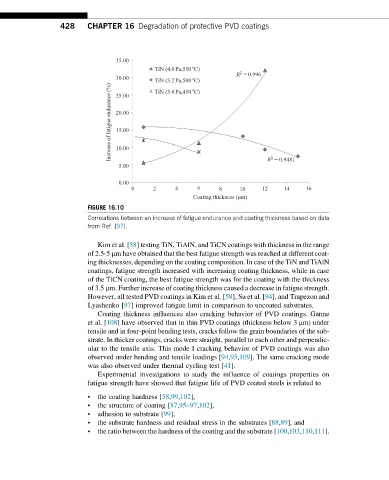
                         FIGURE 16.10
                         Correlations between an increase of fatigue endurance and coating thickness based on data
                         from Ref. [97].

                            Kim et al. [58] testing TiN, TiAlN, and TiCN coatings with thickness in the range
                         of 2.5-5 μm have obtained that the best fatigue strength was reached at different coat-
                         ing thicknesses, depending on the coating composition. In case of the TiN and TiAlN
                         coatings, fatigue strength increased with increasing coating thickness, while in case
                         of the TiCN coating, the best fatigue strength was for the coating with the thickness
                         of 3.5 μm. Further increase of coating thickness caused a decrease in fatigue strength.
                         However, all tested PVD coatings in Kim et al. [58], Su et al. [94], and Trapezon and
                         Lyashenko [97] improved fatigue limit in comparison to uncoated substrates.
                            Coating thickness influences also cracking behavior of PVD coatings. Ganne
                         et al. [108] have observed that in thin PVD coatings (thickness below 3 μm) under
                         tensile and in four-point bending tests, cracks follow the grain boundaries of the sub-
                         strate. In thicker coatings, cracks were straight, parallel to each other and perpendic-
                         ular to the tensile axis. This mode I cracking behavior of PVD coatings was also
                         observed under bending and tensile loadings [94,95,109]. The same cracking mode
                         was also observed under thermal cycling test [41].
                            Experimental investigations to study the influence of coatings properties on
                         fatigue strength have showed that fatigue life of PVD coated steels is related to
                         •  the coating hardness [58,99,102],
                         •  the structure of coating [87,95–97,102],
                         •  adhesion to substrate [99],
                         •  the substrate hardness and residual stress in the substrates [88,89], and
                         •  the ratio between the hardness of the coating and the substrate [100,103,110,111].

