


Page 428 - Handbook of Materials Failure Analysis
P. 428
426    CHAPTER 16 Degradation of protective PVD coatings


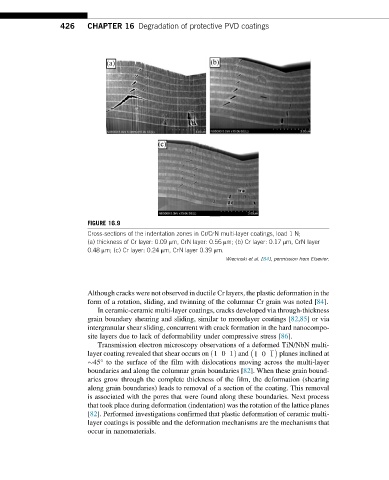
                         FIGURE 16.9
                         Cross-sections of the indentation zones in Cr/CrN multi-layer coatings, load 1 N;
                         (a) thickness of Cr layer: 0.09 μm, CrN layer: 0.56 μm; (b) Cr layer: 0.17 μm, CrN layer
                         0.48 μm; (c) Cr layer: 0.24 μm, CrN layer 0.39 μm.
                                                                Wiecinski et al. [84], permission from Elsevier.


                         Although cracks were not observed in ductile Cr layers, the plastic deformation in the
                         form of a rotation, sliding, and twinning of the columnar Cr grain was noted [84].
                            In ceramic-ceramic multi-layer coatings, cracks developed via through-thickness
                         grain boundary shearing and sliding, similar to monolayer coatings [82,85] or via
                         intergranular shear sliding, concurrent with crack formation in the hard nanocompo-
                         site layers due to lack of deformability under compressive stress [86].
                            Transmission electron microscopy observations of a deformed TiN/NbN multi-

                         layer coating revealed that shear occurs on 1 0 1Þ and 10 1 planes inclined at
                                                           ð
                          45° to the surface of the film with dislocations moving across the multi-layer
                         boundaries and along the columnar grain boundaries [82]. When these grain bound-
                         aries grow through the complete thickness of the film, the deformation (shearing
                         along grain boundaries) leads to removal of a section of the coating. This removal
                         is associated with the pores that were found along these boundaries. Next process
                         that took place during deformation (indentation) was the rotation of the lattice planes
                         [82]. Performed investigations confirmed that plastic deformation of ceramic multi-
                         layer coatings is possible and the deformation mechanisms are the mechanisms that
                         occur in nanomaterials.

