


Page 423 - Handbook of Materials Failure Analysis
P. 423
4 Properties of Multi-Layer Coatings  421


                                        Columnar shear crack  Inclined shear crack
                                                   Film thickness
                                             1.6     3.5     4.9   5.9
                                     0
                                AI
                                     2
                              Substrate hardness  4 6
                                MS


                                SS
                                     8
                                HSS
                                    10
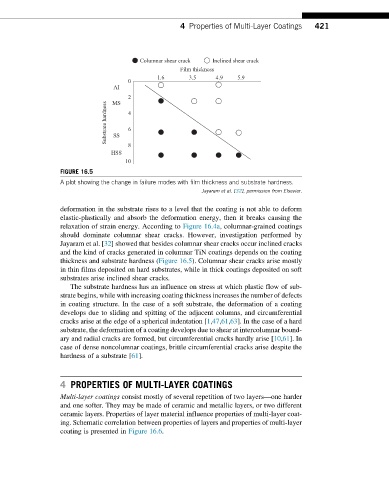
                  FIGURE 16.5
                  A plot showing the change in failure modes with film thickness and substrate hardness.
                                                         Jayaram et al. [32], permission from Elsevier.

                  deformation in the substrate rises to a level that the coating is not able to deform
                  elastic-plastically and absorb the deformation energy, then it breaks causing the
                  relaxation of strain energy. According to Figure 16.4a, columnar-grained coatings
                  should dominate columnar shear cracks. However, investigation performed by
                  Jayaram et al. [32] showed that besides columnar shear cracks occur inclined cracks
                  and the kind of cracks generated in columnar TiN coatings depends on the coating
                  thickness and substrate hardness (Figure 16.5). Columnar shear cracks arise mostly
                  in thin films deposited on hard substrates, while in thick coatings deposited on soft
                  substrates arise inclined shear cracks.
                     The substrate hardness has an influence on stress at which plastic flow of sub-
                  strate begins, while with increasing coating thickness increases the number of defects
                  in coating structure. In the case of a soft substrate, the deformation of a coating
                  develops due to sliding and spitting of the adjacent columns, and circumferential
                  cracks arise at the edge of a spherical indentation [1,47,61,63]. In the case of a hard
                  substrate, the deformation of a coating develops due to shear at intercolumnar bound-
                  ary and radial cracks are formed, but circumferential cracks hardly arise [10,61]. In
                  case of dense noncolumnar coatings, brittle circumferential cracks arise despite the
                  hardness of a substrate [61].


                  4 PROPERTIES OF MULTI-LAYER COATINGS
                  Multi-layer coatings consist mostly of several repetition of two layers—one harder
                  and one softer. They may be made of ceramic and metallic layers, or two different
                  ceramic layers. Properties of layer material influence properties of multi-layer coat-
                  ing. Schematic correlation between properties of layers and properties of multi-layer
                  coating is presented in Figure 16.6.

